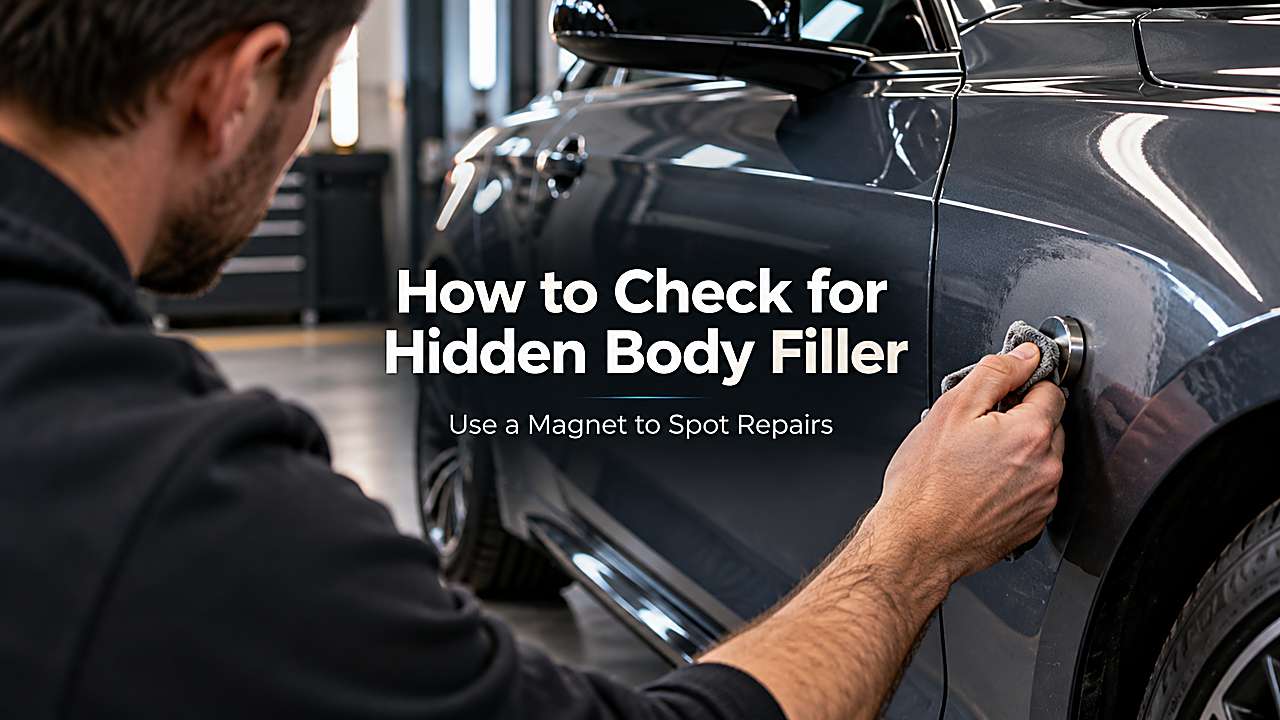
A magnet can help reveal thick body filler on steel because attraction weakens as nonmagnetic material builds between the magnet and metal. It is only a screening test: it does not work properly on aluminum or plastic, and suspicious areas should be confirmed with a paint-thickness gauge or body inspection.
If you are working through how to check for hidden body filler with a magnet, the practical goal is to reduce uncertainty before money changes hands. The rest of this guide shows you which evidence matters, what a seller can reasonably explain and when a specialist is worth the cost.
A magnet can help reveal thick body filler on steel because attraction weakens as nonmagnetic material builds between the magnet and metal. It is only a screening test: it does not work properly on aluminum or plastic, and suspicious areas should be confirmed with a paint-thickness gauge or body inspection.
Know what the magnet is actually detecting
Magnet attraction reaches steel. Filler increases distance. Weak attraction is a clue, not proof.
Strong magnets can still pull through filler. That distinction matters because a used-car decision is rarely controlled by one clue. You get a stronger answer when paperwork, physical condition and independent evidence all point in the same direction.
Identify the panel material first
This part is easier to use when you separate the observation from the conclusion. Work through the checks below and keep the evidence tied to the actual car in front of you.
What to check
Steel can be screened magnetically. Plastic bumpers and composites make the test meaningless. Use the result as a reason for the next check, not as permission to jump straight to a conclusion. A good inspection narrows uncertainty step by step and stops when the evidence becomes too expensive or risky to ignore.
A test section, comparison panel or written quote is more useful than a confident guess. Repeatable evidence protects you from both unnecessary fear and an expensive assumption.
How to verify
Aluminum will not attract normally. Modern cars mix materials. You should also think about resale. A condition you are willing to accept today may still affect what the next buyer, lender or dealer is willing to pay later, so price the future limitation into today’s decision.
Do not let a highly visible cosmetic issue distract you from ownership, mechanical and safety checks. The biggest repair on a used car is often not the one you can see from ten feet away.
Use a low-risk comparison method
This part is easier to use when you separate the observation from the conclusion. Work through the checks below and keep the evidence tied to the actual car in front of you.
What to check
Wrap a small magnet in a thin clean cloth. Compare several nearby spots. You should also think about resale. A condition you are willing to accept today may still affect what the next buyer, lender or dealer is willing to pay later, so price the future limitation into today’s decision.
Do not let a highly visible cosmetic issue distract you from ownership, mechanical and safety checks. The biggest repair on a used car is often not the one you can see from ten feet away.
How to verify
Lift vertically instead of sliding. If the seller can support the explanation with records and the car behaves consistently with the story, the finding may be harmless. When the explanation changes or inspection access is restricted, give the same clue more weight.
Keep the transaction numbers separate whenever possible. Purchase price, trade value, financing, repair cost and taxes are easier to judge when one figure is not hiding another.
What changes the decision
Establish normal pull on an undamaged area. A test section, comparison panel or written quote is more useful than a confident guess. Repeatable evidence protects you from both unnecessary fear and an expensive assumption.
When the issue crosses into structure, airbags, title status, flood exposure or expensive diagnostics, pay for a specialist. The inspection fee is small compared with inheriting a problem you cannot verify yourself.
Map a suspicious repair instead of testing one point
This part is easier to use when you separate the observation from the conclusion. Work through the checks below and keep the evidence tied to the actual car in front of you.
What to check
Move in a grid. Changes near waves or mismatched paint matter more. If the seller can support the explanation with records and the car behaves consistently with the story, the finding may be harmless. When the explanation changes or inspection access is restricted, give the same clue more weight.
Keep the transaction numbers separate whenever possible. Purchase price, trade value, financing, repair cost and taxes are easier to judge when one figure is not hiding another.
How to verify
Compare opposite-side panels when construction matches. Edges and curves can alter feel. A test section, comparison panel or written quote is more useful than a confident guess. Repeatable evidence protects you from both unnecessary fear and an expensive assumption.
When the issue crosses into structure, airbags, title status, flood exposure or expensive diagnostics, pay for a specialist. The inspection fee is small compared with inheriting a problem you cannot verify yourself.
Confirm with a paint-thickness gauge
Dual fe/nfe gauges can measure coatings on steel and aluminum. Compare patterns across the car. Very high or inconsistent readings can indicate repaint or filler.
One magic number is unreliable. A test section, comparison panel or written quote is more useful than a confident guess. Repeatable evidence protects you from both unnecessary fear and an expensive assumption.
Look for supporting bodywork clues
Overspray. Masking lines. Sanding texture. Pinholes.
Changing body-line shape. Disturbed bolts and inconsistent seam sealer. Do not let a highly visible cosmetic issue distract you from ownership, mechanical and safety checks. The biggest repair on a used car is often not the one you can see from ten feet away.
Keep the transaction numbers separate whenever possible. Purchase price, trade value, financing, repair cost and taxes are easier to judge when one figure is not hiding another.
Decide whether filler is cosmetic or a bigger warning
Small skim after a minor dent can be acceptable. Deep filler plus poor gaps or structural clues deserves collision-shop inspection.
Repair quality matters more than the existence of filler alone. Keep the transaction numbers separate whenever possible. Purchase price, trade value, financing, repair cost and taxes are easier to judge when one figure is not hiding another.
Document the inspection before you leave
Take clear photos of the VIN, odometer, visible defects and any document that matters to the deal. Write down the seller’s explanation for a significant repair or title issue while it is fresh. If you later compare three similar vehicles, these notes keep the facts separate. Documentation also gives you a better basis for a repair quote or negotiation.
Keep the transaction numbers separate whenever possible. Purchase price, trade value, financing, repair cost and taxes are easier to judge when one figure is not hiding another.
A Faster First Pass for How To Check For Hidden Body Filler With A Magnet
This section turns the earlier principles into a practical decision you can use on the actual vehicle rather than treating the topic as an abstract rule.
Before you inspect the detailed clues
Start with steel-versus-aluminum panel identification. Confirm that the VIN and seller story make sense, then look at the whole vehicle from several steps away before focusing on one suspicious area. A broad first look helps you notice asymmetry, stance, panel fit and signs that one side of the car has received much more work than the other. Do not let one clever test replace the basic walk-around.
Keep the conclusion proportional to the evidence. If the finding is uncertain but inexpensive to verify, verify it. If it is uncertain and potentially expensive, do not let the seller make that uncertainty your financial responsibility.
Cross-check the clue with another source
Use paint-thickness confirmation as the second layer of evidence. The strongest used-car findings are independent of one another: a physical clue, a record and a professional observation that point to the same history. If one source contradicts the others, slow down and find out why. That is especially important when a seller has a confident explanation but no documents.
Keep the conclusion proportional to the evidence. If the finding is uncertain but inexpensive to verify, verify it. If it is uncertain and potentially expensive, do not let the seller make that uncertainty your financial responsibility.
Escalate when the finding affects safety or resale
Once the concern reaches collision-repair quality, stop treating it as a cosmetic negotiation point. Ask for an independent inspection from a shop equipped to evaluate that system or repair. The purpose is not to prove the seller wrong. It is to learn whether the car can be owned, insured and resold without a risk that the current price does not cover.
Keep the conclusion proportional to the evidence. If the finding is uncertain but inexpensive to verify, verify it. If it is uncertain and potentially expensive, do not let the seller make that uncertainty your financial responsibility.
What a Good Seller Response Looks Like
This section turns the earlier principles into a practical decision you can use on the actual vehicle rather than treating the topic as an abstract rule.
Specific records beat reassurance
A useful seller response to a question about steel-versus-aluminum panel identification includes dates, invoices, photos or a clear ownership timeline. “It was like that when I bought it” may be honest, but it does not reduce your uncertainty. You can still proceed, but price the car as one with incomplete history until independent inspection fills the gap.
Keep the conclusion proportional to the evidence. If the finding is uncertain but inexpensive to verify, verify it. If it is uncertain and potentially expensive, do not let the seller make that uncertainty your financial responsibility.
Inspection access matters
A seller who allows you to verify paint-thickness confirmation gives you a way to resolve uncertainty. Reasonable access can include a cold start, diagnostic scan, lift inspection or body-shop visit depending on the issue. If the seller refuses every outside check while asking full market price, another vehicle is usually a better use of your time.
Keep the conclusion proportional to the evidence. If the finding is uncertain but inexpensive to verify, verify it. If it is uncertain and potentially expensive, do not let the seller make that uncertainty your financial responsibility.
Why Magnet Results Need a Second Test
Start with steel panel material. This is the part of the decision that should be known before you spend money or make a final offer. Put the evidence in writing and compare it with at least one realistic alternative. When buyers skip this step, they often let the visible condition or the seller’s urgency set the number for them. A better approach is to establish what the car or transaction would be worth if this issue did not exist, then measure the actual gap instead of guessing.
Next, verify paint-thickness readings. A quoted number, diagnostic result or document is useful only when it applies to the exact vehicle and the exact problem. Ask what is included, what is excluded and what could change after disassembly or verification. If the range is wide, use the conservative end in your budget. That protects you from a deal that looks profitable or affordable only because every uncertain item was calculated at the best possible outcome.
Finally, consider repair quality. Used-car decisions do not end on the day you sign or sell. Insurance, future trade value, buyer confidence, repeat repairs and paperwork can continue affecting the car after the immediate problem is solved. If the transaction still makes sense after you include that future friction, you have a much stronger decision. If the deal only works when every future buyer ignores the same concern, the current discount is probably too small.
Frequently Asked Questions
These questions cover the points that most often create false confidence when you are dealing with how to check for hidden body filler with a magnet. The answers stay focused on what you can verify before the transaction.
Will a magnet stick through body filler?
A magnet can still attract steel through thin filler or paint, so the useful clue is a change in pull compared with nearby steel. Material type and magnet strength affect the result.
If this point could materially change price, safety, title status or a major repair decision, verify it before the transaction rather than using the FAQ as a substitute for the specific vehicle evidence.
What type of magnet is safest for car paint?
Use a small low-strength magnet or purpose-built magnetic gauge and protect the finish with a clean thin barrier. Avoid sliding the magnet across paint.
If this point could materially change price, safety, title status or a major repair decision, verify it before the transaction rather than using the FAQ as a substitute for the specific vehicle evidence.
Can a magnet find filler on an aluminum hood?
No. Aluminum is nonferrous, so a normal magnet will not provide a meaningful filler check. Use a dual-substrate coating-thickness gauge instead.
If this point could materially change price, safety, title status or a major repair decision, verify it before the transaction rather than using the FAQ as a substitute for the specific vehicle evidence.
Does finding body filler mean the car had a major accident?
No. Filler can be used after small cosmetic repairs as well as larger collisions. The surrounding repair quality and structure determine significance.
If this point could materially change price, safety, title status or a major repair decision, verify it before the transaction rather than using the FAQ as a substitute for the specific vehicle evidence.
Is a paint-thickness gauge better than a magnet?
Usually, yes. A dual Fe/NFe gauge gives repeatable coating-thickness readings on steel and aluminum, although it still needs comparison and interpretation.
If this point could materially change price, safety, title status or a major repair decision, verify it before the transaction rather than using the FAQ as a substitute for the specific vehicle evidence.
Conclusion
With how to check for hidden body filler with a magnet, the best decision is the one supported by evidence you can repeat and explain. Answer the main question early, then verify the few details that could change the price, safety or ownership outcome.
If the vehicle still makes sense after those checks, you can move forward or negotiate with a clearer number. If it does not, walking away is a successful inspection rather than a missed deal.