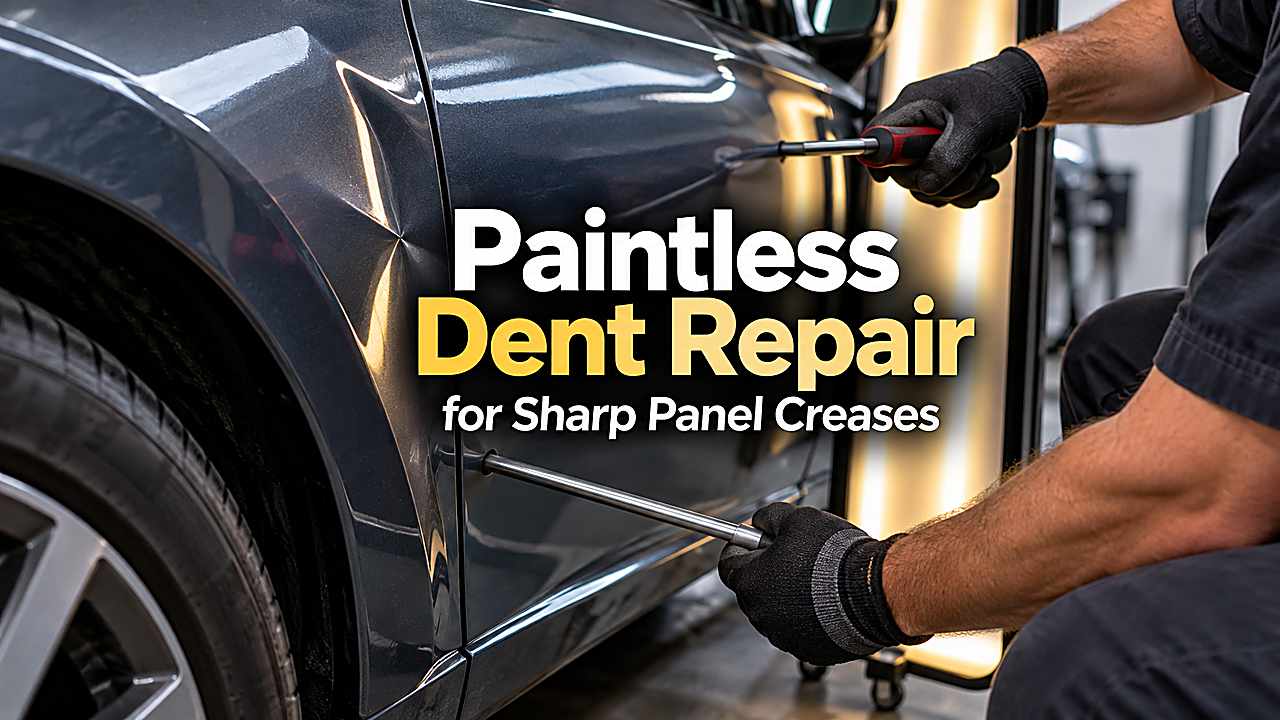
A sharp crease is one of the more demanding dents a paintless dent repair technician can face. The metal has not simply moved inward; it has been concentrated along a narrow line, often with high and low spots that must be restored without breaking the finish.
Some sharp creases can be improved or even restored with PDR, but the decision depends on paint condition, metal stretch, panel location, access and how tightly the metal folded. A crease that looks small can be harder than a much wider shallow dent.
Paintless dent repair can fix some sharp panel creases when the paint is intact and the metal has not been severely stretched or folded. Very sharp, edge-adjacent or paint-cracked creases often need conventional body repair.
Why a sharp crease is harder than a round dent
The metal is concentrated into a narrow low
A broad dent spreads displacement across a larger area. A sharp crease concentrates stress into a thin channel, so the technician must release tension gradually rather than simply push the center outward. That distinction matters because a repair should be chosen for the condition of the panel, not for the name of the technique.
The crease may also have crowns beside it, which are raised areas created as displaced metal moves outward. Those crowns have to be managed along with the low spot or the panel can remain wavy. This is why crease work is judged by shape and tension, not only by length. A careful estimate should therefore describe the limiting factor rather than relying on dent size alone.
Paint flexibility becomes part of the repair
PDR preserves the existing finish, so intact paint is fundamental. A crease can bend the paint and clear coat more severely than a soft ding, especially at the deepest point. Looking at the panel in reflected light is useful because subtle crowns, waves and coating damage are easy to miss in flat lighting.
Fine cracking, chipping or previous refinishing changes the risk because manipulating the metal can worsen an already weakened coating. Good lighting and close inspection are therefore part of the estimate, not an optional cosmetic check. The practical goal is a stable, natural contour that remains convincing from normal viewing angles, not merely a dent that looks smaller in one photograph.
What makes a sharp crease a realistic PDR candidate
This section breaks the decision into the factors that matter most for paintless dent repair for sharp panel creases. The details are worth separating because two dents that look similar at first glance can require very different repair strategies.
1. The paint remains intact.
A crease with sound factory paint gives the technician the best chance to work the metal without creating a refinishing problem. The surface should be inspected from several angles because tiny cracks can hide in the deepest portion of the line. Previous repairs, unusual materials and restricted access can change the plan, so owners should mention anything they know about the panel’s history.
Dirt and reflections can also conceal chips, so a clean panel is easier to assess. If paint is already broken, PDR may still move the metal, but it no longer completes the cosmetic repair by itself. When the damage is borderline, an experienced technician should be willing to explain what result is realistic before work begins.
2. The metal has not been severely stretched.
Metal that has merely displaced can often be persuaded toward its original contour. Severe stretching creates excess surface area, making the panel reluctant to hold the original shape even after the low spot is raised. That distinction matters because a repair should be chosen for the condition of the panel, not for the name of the technique.
Signs include an unusually deep center, a broad oil-canning area or a dent that changes shape with light hand pressure. Those symptoms deserve an in-person assessment because conventional metalwork may be more appropriate. A careful estimate should therefore describe the limiting factor rather than relying on dent size alone.
3. The technician can reach or safely pull the damage.
Backside access allows precise pressure with PDR rods, while glue pulling can help when access is limited and the finish is suitable. Braces, double-wall construction, panel edges and tightly boxed sections can restrict both approaches. Looking at the panel in reflected light is useful because subtle crowns, waves and coating damage are easy to miss in flat lighting.
A crease may therefore be repairable on one part of a door but impractical only a few inches away. Access is one reason photos alone sometimes cannot produce a final yes-or-no answer. The practical goal is a stable, natural contour that remains convincing from normal viewing angles, not merely a dent that looks smaller in one photograph.
4. The crease is not tightly folded into an edge.
Panel edges and hems are stiffer than open sheet metal because several layers or formed structures may meet there. A razor-like crease against an edge can also contain a much tighter fold than its visible size suggests. Previous repairs, unusual materials and restricted access can change the plan, so owners should mention anything they know about the panel’s history.
Working that area too aggressively risks paint damage or an uneven edge profile. Creases farther from the edge generally give the technician more room to blend the repair. When the damage is borderline, an experienced technician should be willing to explain what result is realistic before work begins.
How technicians approach difficult crease repairs
This section breaks the decision into the factors that matter most for paintless dent repair for sharp panel creases. The details are worth separating because two dents that look similar at first glance can require very different repair strategies.
Controlled pushes rebuild the low gradually
Experienced PDR work is a sequence of very small corrections. The technician reads reflections from a line board or light, identifies the lowest points and makes controlled pushes rather than trying to pop the entire crease at once. That distinction matters because a repair should be chosen for the condition of the panel, not for the name of the technique.
Raised crowns may be tapped down as the low rises so panel tension stays balanced. The goal is to recreate the original contour without trading one obvious defect for a field of tiny highs. A careful estimate should therefore describe the limiting factor rather than relying on dent size alone.
Heat may be used carefully to support paint flexibility
Moderate, controlled warming is sometimes used during difficult repairs to help the finish tolerate movement, particularly in cooler conditions. Heat is not a cure for stretched metal and it does not make cracked paint intact again. Looking at the panel in reflected light is useful because subtle crowns, waves and coating damage are easy to miss in flat lighting.
Excessive temperature can damage coatings, trim or adhesives, so professional temperature control matters. The repair still depends primarily on accurate metal movement. The practical goal is a stable, natural contour that remains convincing from normal viewing angles, not merely a dent that looks smaller in one photograph.
Finish expectations should be discussed before work begins
A mild sharp crease in a favorable location may respond extremely well, while a severe fold can leave some residual texture even after major improvement. A technician should explain whether the target is full restoration, near-invisible improvement or simply reducing the damage. Previous repairs, unusual materials and restricted access can change the plan, so owners should mention anything they know about the panel’s history.
That conversation is especially important on older panels, repainted surfaces and complex body lines. A realistic target prevents a technically successful repair from becoming a disappointing one. When the damage is borderline, an experienced technician should be willing to explain what result is realistic before work begins.
When conventional body repair is the better route
Cracked paint changes the job
Once the finish has cracked, the panel may require sanding, primer, color and clear coat even if PDR can reduce the dent first. Conventional repair can also address damaged coating at the same time as the shape. That distinction matters because a repair should be chosen for the condition of the panel, not for the name of the technique.
Trying to preserve paint that is already failing can postpone rather than solve the visible problem. The correct repair should address both metal and finish. A careful estimate should therefore describe the limiting factor rather than relying on dent size alone.
Severe folds, torn metal and structural damage are outside normal PDR
A crease created by a substantial collision may involve more than cosmetic sheet-metal movement. Torn metal, distorted seams, damaged reinforcements or poor door operation point toward body-shop assessment. Looking at the panel in reflected light is useful because subtle crowns, waves and coating damage are easy to miss in flat lighting.
PDR is designed for suitable cosmetic dents, not for restoring compromised structural components. Safety and correct panel geometry take priority over avoiding paintwork. The practical goal is a stable, natural contour that remains convincing from normal viewing angles, not merely a dent that looks smaller in one photograph.
Frequently Asked Questions
Can PDR remove a razor-sharp crease completely?
Sometimes, but a razor-sharp crease is a high-difficulty repair. Success depends on intact paint, limited metal stretch, workable access and enough space around the crease to manage panel tension. A short but deeply folded crease can be harder than a long shallow one. An experienced technician can usually give a better expectation after seeing the panel under proper lighting. Previous repairs, unusual materials and restricted access can change the plan, so owners should mention anything they know about the panel’s history.
The most reliable answer comes from evaluating the actual panel under good lighting and considering finish condition, geometry and access together. Photos can narrow the possibilities, but borderline damage may need an in-person inspection before a technician can promise a specific result.
Does the length of the crease determine whether PDR works?
No. Length matters, but depth, sharpness, location and metal stretch often matter more. A long, shallow crease across open sheet metal can be more manageable than a one-inch fold beside a panel edge. Access behind the damage also changes the repair. Size should therefore be treated as one part of the assessment rather than a pass-or-fail rule. When the damage is borderline, an experienced technician should be willing to explain what result is realistic before work begins.
The most reliable answer comes from evaluating the actual panel under good lighting and considering finish condition, geometry and access together. Photos can narrow the possibilities, but borderline damage may need an in-person inspection before a technician can promise a specific result.
Will PDR crack the paint on a sharp crease?
A competent technician works to minimize that risk, but no difficult crease repair is completely risk-free. Paint that was already stressed, aged, chipped or refinished may be less tolerant of movement. Careful inspection and controlled technique reduce the chance of damage. If the coating is already cracked, refinishing may be needed regardless of how the metal is corrected. That distinction matters because a repair should be chosen for the condition of the panel, not for the name of the technique.
The most reliable answer comes from evaluating the actual panel under good lighting and considering finish condition, geometry and access together. Photos can narrow the possibilities, but borderline damage may need an in-person inspection before a technician can promise a specific result.
Can glue pulling fix a sharp crease with no backside access?
Glue pulling can help with some inaccessible creases, but it is not automatically suitable for every finish or dent. The method has to create controlled lifts without pulling paint or over-raising the panel. Sharp folds may still need detailed finishing that is difficult from the outside alone. A technician may combine external pulling with other techniques when safe access becomes available. A careful estimate should therefore describe the limiting factor rather than relying on dent size alone.
The most reliable answer comes from evaluating the actual panel under good lighting and considering finish condition, geometry and access together. Photos can narrow the possibilities, but borderline damage may need an in-person inspection before a technician can promise a specific result.
Is a crease on a body line harder to repair?
Usually, because the technician has to restore both the dent and the intended character line. The line acts as a shaped feature with its own tension, so a small error can remain visible in reflections. Some soft body-line dents are good PDR candidates, while very sharp contoured damage can exceed practical PDR limits. The exact geometry determines the answer. Looking at the panel in reflected light is useful because subtle crowns, waves and coating damage are easy to miss in flat lighting.
The most reliable answer comes from evaluating the actual panel under good lighting and considering finish condition, geometry and access together. Photos can narrow the possibilities, but borderline damage may need an in-person inspection before a technician can promise a specific result.
Conclusion
PDR can fix some sharp panel creases when the paint is intact and the metal has not been severely stretched or folded. Very sharp, edge-adjacent or paint-cracked creases often need conventional body repair. The sensible next step is to photograph the damage clearly, note any paint or functional problems, and obtain an estimate from a technician whose experience matches the panel and damage type.
Choosing the repair from the actual condition of the metal and finish helps preserve original material when that is realistic, while avoiding the mistake of forcing a paintless method onto damage that needs conventional body or refinishing work.