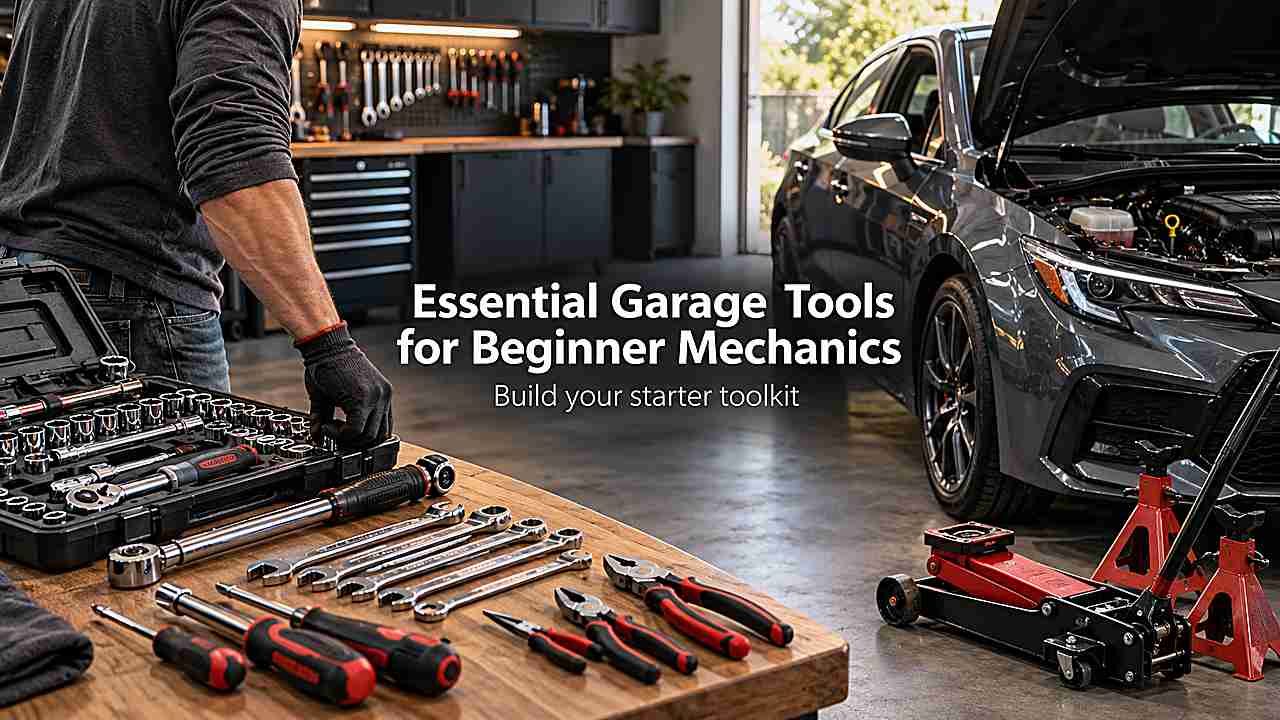
A beginner mechanic does not need a wall of expensive tools. Start with a safe floor jack and correctly rated jack stands, wheel chocks, a 3/8-inch socket and ratchet set, combination wrenches, torque wrench, breaker bar, screwdrivers and pliers, a multimeter, OBD2 scanner, strong work light and basic fluid-service equipment.
The most important rule is simple: never work underneath a vehicle supported only by a hydraulic jack. Spend your first money on safe lifting and accurate torque before specialty tools.
Build your first garage kit around safety, fastener tools, measurement and diagnosis. Add specialty tools only when a specific job requires them, because cheap unused specialty tools are less valuable than a good torque wrench, lighting and jack stands.
Tier 1: safety and lifting equipment comes first
The most reliable way to use this section is to treat each check separately. One good sign should not cancel several bad ones, and one questionable sign should be verified before you assume the worst.
Floor jack
Choose a jack with enough capacity and lift range for your vehicle. A low-profile design helps with cars, while trucks and SUVs may need more height.
The jack raises the car; it is not the support you work under. Keep copies of photos, scan reports, quotes and key paperwork when the finding affects price. Clear documentation makes negotiation shorter and prevents memory from becoming less accurate after you have viewed several vehicles.
Resale matters too. A condition you are willing to accept today can still reduce the number of future buyers, dealer trade options or insurance choices, so include the exit value in the purchase decision.
Jack stands
Use stands rated for the vehicle and position them only at approved support points. Inspect locking mechanisms before use and work on solid level ground.
Give the vehicle a controlled shake before going underneath. Resale matters too. A condition you are willing to accept today can still reduce the number of future buyers, dealer trade options or insurance choices, so include the exit value in the purchase decision.
Wheel chocks
Chocks prevent the wheels that stay on the ground from rolling. Use them every time you lift a vehicle.
The parking brake and transmission are not substitutes for physical chocks. That distinction matters because the visible symptom is only one part of the decision. You should connect what you see with ownership records, service history, repair cost and what an independent inspection can verify.
Eye protection and gloves
Safety glasses protect you from rust, brake dust and fluid. Gloves improve grip and reduce skin contact with chemicals, though they must not be allowed near rotating machinery.
Keep hearing protection available for impact tools. A useful rule is to treat every finding as a reason for the next check rather than as a final verdict. When several independent clues point in the same direction, your confidence becomes much stronger.
Tier 2: the hand tools that cover most basic jobs
3/8-inch metric socket set with extensions
Modern vehicles use metric fasteners extensively. A quality 3/8-inch ratchet, shallow and deep sockets, and several extensions cover oil service, batteries, brackets and light mechanical work.
Add 1/4-inch tools later for small fasteners. Resale matters too. A condition you are willing to accept today can still reduce the number of future buyers, dealer trade options or insurance choices, so include the exit value in the purchase decision.
Combination wrench set
Wrenches reach fasteners a socket cannot. Buy a complete metric range with comfortable open and box ends. Ratcheting versions are convenient but not required.
Avoid using an adjustable wrench when the correct size is available. That distinction matters because the visible symptom is only one part of the decision. You should connect what you see with ownership records, service history, repair cost and what an independent inspection can verify.
Breaker bar
A breaker bar provides controlled leverage on stubborn lug nuts and suspension fasteners. It is safer for high torque than extending a ratchet with a pipe.
Use penetrating oil and correct sockets on rusted hardware. A useful rule is to treat every finding as a reason for the next check rather than as a final verdict. When several independent clues point in the same direction, your confidence becomes much stronger.
Screwdrivers, picks and pliers
Flat and Phillips screwdrivers, needle-nose pliers, slip-joint pliers and hose-pick tools handle clips, clamps and connectors. Plastic trim tools are worth adding because modern cars use fragile interior fasteners.
Do not let a low asking price change the standard of proof you require. A cheap vehicle with unclear title, structural or mechanical risk can cost far more than a correctly priced car with honest cosmetic wear.
If the seller can document the explanation and the vehicle supports it, the issue may be manageable. If the story changes or inspection access is restricted, that uncertainty deserves real weight in your decision.
Tier 3: torque and measurement tools
The most reliable way to use this section is to treat each check separately. One good sign should not cancel several bad ones, and one questionable sign should be verified before you assume the worst.
Click-type or digital torque wrench
Wheel lugs, drain plugs and many engine fasteners have specified torque values. A torque wrench helps you avoid stripped threads and under-tightening.
Store click-type tools at their specified low setting and calibrate according to manufacturer guidance. That distinction matters because the visible symptom is only one part of the decision. You should connect what you see with ownership records, service history, repair cost and what an independent inspection can verify.
Tire-pressure gauge
A separate accurate gauge is cheap and useful even if the car has TPMS. Set pressure to the placard when tires are cold.
Do not use the maximum sidewall pressure as your target. A useful rule is to treat every finding as a reason for the next check rather than as a final verdict. When several independent clues point in the same direction, your confidence becomes much stronger.
Digital multimeter
Voltage, resistance and continuity checks make electrical troubleshooting far more precise than guessing. Learn basic meter safety before probing circuits.
Start with battery and charging-system tests. Do not let a low asking price change the standard of proof you require. A cheap vehicle with unclear title, structural or mechanical risk can cost far more than a correctly priced car with honest cosmetic wear.
If the seller can document the explanation and the vehicle supports it, the issue may be manageable. If the story changes or inspection access is restricted, that uncertainty deserves real weight in your decision.
Tier 4: basic diagnostic tools
OBD2 scanner
Even an inexpensive scanner can read engine codes and readiness monitors, while enhanced tools add ABS and airbag coverage. Do not replace parts just because a code mentions a component.
Codes identify a system or condition, not always the failed part. A useful rule is to treat every finding as a reason for the next check rather than as a final verdict. When several independent clues point in the same direction, your confidence becomes much stronger.
Inspection light and flashlight
Good light is diagnostic equipment. Use a bright rechargeable work light under the hood and a compact flashlight for leaks and underbody inspection.
Magnetic mounting is useful but keep magnets away from delicate finished surfaces. Do not let a low asking price change the standard of proof you require. A cheap vehicle with unclear title, structural or mechanical risk can cost far more than a correctly priced car with honest cosmetic wear.
If the seller can document the explanation and the vehicle supports it, the issue may be manageable. If the story changes or inspection access is restricted, that uncertainty deserves real weight in your decision.
Tier 5: fluid-service equipment
The most reliable way to use this section is to treat each check separately. One good sign should not cancel several bad ones, and one questionable sign should be verified before you assume the worst.
Drain pan and funnel set
A stable drain pan prevents spills during oil and coolant work. Keep dedicated funnels for different fluids so contamination does not move between systems.
Dispose of used fluids according to local rules. Do not let a low asking price change the standard of proof you require. A cheap vehicle with unclear title, structural or mechanical risk can cost far more than a correctly priced car with honest cosmetic wear.
If the seller can document the explanation and the vehicle supports it, the issue may be manageable. If the story changes or inspection access is restricted, that uncertainty deserves real weight in your decision.
Oil-filter wrench
The correct tool depends on filter design. Cap-style tools work well on cartridge housings, while strap or plier types fit some spin-on filters.
Do not crush a housing with the wrong tool. If the seller can document the explanation and the vehicle supports it, the issue may be manageable. If the story changes or inspection access is restricted, that uncertainty deserves real weight in your decision.
Fluid transfer pump
A simple hand pump is useful for gear oil and some differential services. Use dedicated pumps for incompatible fluids.
Follow the manufacturer’s fill-level procedure. Your final number should include the repair or ownership cost that will actually fall on you, not a generic internet average. Local labor rates, vehicle design and parts availability can change the economics quickly.
Tools you can wait to buy
Impact wrenches, scan tablets, compression testers, spring compressors, brake-bleeding machines and specialty pullers are valuable only when your repair work actually calls for them. Borrow, rent or buy job-specific tools as your skill grows. A smaller set of dependable general tools is a better first garage than a giant low-quality kit. A useful rule is to treat every finding as a reason for the next check rather than as a final verdict. When several independent clues point in the same direction, your confidence becomes much stronger.
Organize the garage so tools stay safe
Use labeled drawers, keep torque tools protected and separate clean diagnostic tools from greasy impact sockets. Store batteries and chargers away from fluids. Keep a fire extinguisher appropriate for garage hazards accessible.
A tidy work area prevents lost fasteners and makes it easier to notice leaks or damage. Do not let a low asking price change the standard of proof you require. A cheap vehicle with unclear title, structural or mechanical risk can cost far more than a correctly priced car with honest cosmetic wear.
Your first five jobs should be low-risk learning work
Tire rotations, cabin and engine air filters, battery replacement, wiper service and simple oil changes can build tool familiarity. Move into brakes, suspension and electrical diagnosis only after you understand safe lifting and torque. There is no reward for choosing a repair that is beyond your current skill simply because you own the tool. If the seller can document the explanation and the vehicle supports it, the issue may be manageable. If the story changes or inspection access is restricted, that uncertainty deserves real weight in your decision.
Buy for the jobs you will actually do
A tool earns its space by solving a recurring task safely and efficiently. Before spending, list the vehicles and jobs you expect to handle during the next year, then choose accessories and capacity around those needs. This keeps a beginner kit practical instead of turning it into a collection of unused specialty equipment.
A useful rule is to treat every finding as a reason for the next check rather than as a final verdict. When several independent clues point in the same direction, your confidence becomes much stronger.
Frequently Asked Questions
A beginner garage becomes useful when the tools match the work you can perform safely. These questions help you spend money in the right order.
What size socket set should a beginner buy first?
A metric 3/8-inch-drive set is the most versatile first purchase for many modern vehicles. Add deep sockets and extensions.
A 1/4-inch set is useful for interior and small engine fasteners, while 1/2-inch tools come later for high-torque work. That distinction matters because the visible symptom is only one part of the decision. You should connect what you see with ownership records, service history, repair cost and what an independent inspection can verify.
Do you need an impact wrench as a beginner?
No. A breaker bar and hand ratchets can handle many maintenance jobs and teach proper fastener feel. An impact saves time on wheels and suspension but can also overtighten or damage fasteners.
Always finish critical fasteners with a torque wrench. A useful rule is to treat every finding as a reason for the next check rather than as a final verdict. When several independent clues point in the same direction, your confidence becomes much stronger.
Are cheap jack stands safe?
Price alone does not determine safety. Use stands from a reputable manufacturer with adequate rating, clear instructions and no damage or recall concerns. Position them correctly on solid ground.
Never exceed their rating or work under a car supported only by a jack. Do not let a low asking price change the standard of proof you require. A cheap vehicle with unclear title, structural or mechanical risk can cost far more than a correctly priced car with honest cosmetic wear.
What OBD2 scanner should a beginner mechanic buy?
A simple reader is enough for check-engine codes and readiness status, while a Bluetooth enhanced scanner adds live data and manufacturer systems. Buy coverage for the vehicles you actually work on.
Diagnostic skill matters more than the most expensive tool. If the seller can document the explanation and the vehicle supports it, the issue may be manageable. If the story changes or inspection access is restricted, that uncertainty deserves real weight in your decision.
Should you buy a mechanic tool set or individual tools?
A good set can be cost-effective for sockets and wrenches, but large kits often inflate piece count with bits you may never use. Buy a solid core set, then add individual specialty tools as jobs require.
Quality matters most for frequently used ratchets, torque tools and lifting equipment. Your final number should include the repair or ownership cost that will actually fall on you, not a generic internet average. Local labor rates, vehicle design and parts availability can change the economics quickly.
Conclusion
For must have garage tools for beginner car mechanics, the main answer is useful only when you connect it to the actual vehicle, paperwork or tool in front of you. Verify the details that can change safety, legality or repair cost before you commit money.
If the numbers and evidence still make sense after those checks, move forward confidently. If they do not, walking away or choosing the simpler repair is often the most profitable decision.