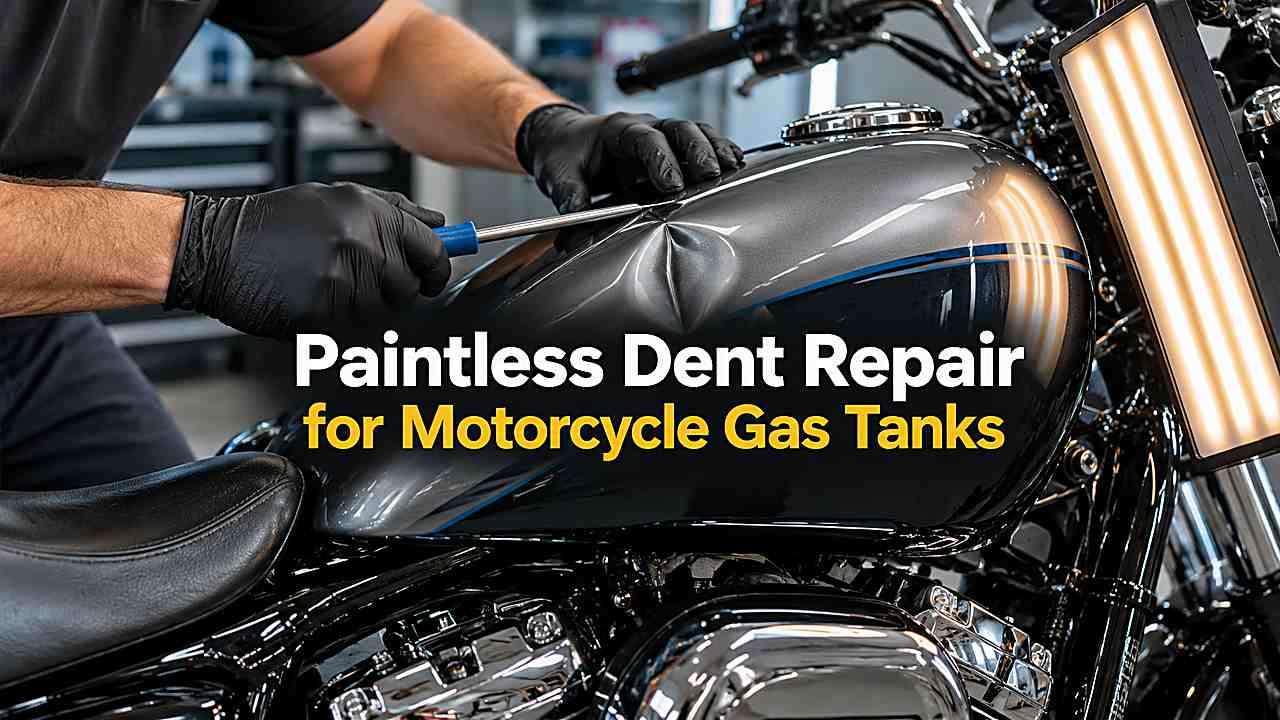
A motorcycle gas tank is one of the most visually prominent painted surfaces on a bike, which makes preserving factory paint, custom graphics or pinstriping especially valuable. It is also a difficult PDR component because the tank is a closed vessel with limited access and strong compound curves.
Many smooth, paint-intact tank dents can be repaired by a specialist, but sharp folds, breached metal, rust and severe stretch can make conventional tank repair or replacement the safer option. Tank work is not a good place for improvised DIY pressure or heat.
PDR can repair many motorcycle gas-tank dents when the paint is intact and the metal has not been sharply folded, torn or severely stretched. Limited access and thicker curved metal make specialist experience especially important.
Why motorcycle tanks are unusually difficult PDR work
This section breaks the decision into the factors that matter most for paintless dent repair for motorcycle gas tanks. The details are worth separating because two dents that look similar at first glance can require very different repair strategies.
Access is far more limited than on a car door
A car door offers several possible service openings once trim is removed. A fuel tank is a closed container with only specific openings and internal geometry, so the technician may have very limited leverage. That distinction matters because a repair should be chosen for the condition of the panel, not for the name of the technique.
Custom rods and model-specific access strategies are common. Some tanks need to be removed from the motorcycle before repair can be performed safely and effectively. A careful estimate should therefore describe the limiting factor rather than relying on dent size alone.
The metal is formed into strong compound curves
Tank shapes combine convex surfaces, tight transitions and stamped features that resist movement. Those curves create panel tension that can make a seemingly simple dent stubborn. Looking at the panel in reflected light is useful because subtle crowns, waves and coating damage are easy to miss in flat lighting.
The technician has to restore the surrounding contour, not just raise the center. Thicker metal on some tanks further increases the force and control required. The practical goal is a stable, natural contour that remains convincing from normal viewing angles, not merely a dent that looks smaller in one photograph.
The finish may be unusually valuable
Factory graphics, custom paint, pinstriping and discontinued colors can make repainting undesirable. PDR’s ability to preserve the existing finish is therefore particularly attractive on motorcycles. Previous repairs, unusual materials and restricted access can change the plan, so owners should mention anything they know about the panel’s history.
That advantage only applies when the coating is sound enough to survive the metal movement. Cracked paint changes the repair decision. When the damage is borderline, an experienced technician should be willing to explain what result is realistic before work begins.
Which tank dents are the best candidates
This section breaks the decision into the factors that matter most for paintless dent repair for motorcycle gas tanks. The details are worth separating because two dents that look similar at first glance can require very different repair strategies.
1. Smooth, shallow impacts with intact paint.
A broad depression from a garage bump, storage incident or similar contact is generally more favorable than a sharp point. The paint should be checked closely at the deepest area. That distinction matters because a repair should be chosen for the condition of the panel, not for the name of the technique.
If the coating remains flexible and the metal is not badly stretched, a specialist may be able to restore the contour. Photos under reflected light help with initial screening. A careful estimate should therefore describe the limiting factor rather than relying on dent size alone.
2. Hail-style dents without sharp creases.
Small rounded impacts can be good candidates when they have not broken the finish. Multiple dents increase labor, but uniform shallow damage is often more predictable than one deeply folded impact. Looking at the panel in reflected light is useful because subtle crowns, waves and coating damage are easy to miss in flat lighting.
Tank curvature still makes access important. A specialist should evaluate whether each low can be reached safely. The practical goal is a stable, natural contour that remains convincing from normal viewing angles, not merely a dent that looks smaller in one photograph.
3. Pressure dents that have not folded the metal.
Tie-down straps and storage pressure can leave elongated lows. These can be more difficult than round dings because the load may have stretched a larger area. Previous repairs, unusual materials and restricted access can change the plan, so owners should mention anything they know about the panel’s history.
A smooth impression is more promising than a narrow crease. The repair target should be discussed from photos and, when necessary, an in-person inspection. When the damage is borderline, an experienced technician should be willing to explain what result is realistic before work begins.
Damage that usually needs another repair path
This section breaks the decision into the factors that matter most for paintless dent repair for motorcycle gas tanks. The details are worth separating because two dents that look similar at first glance can require very different repair strategies.
Sharp folds or torn metal
A razor-like crease can exceed the metal’s recoverable shape and put extreme stress into the finish. If the tank wall is torn, punctured or breached, the issue is no longer cosmetic. That distinction matters because a repair should be chosen for the condition of the panel, not for the name of the technique.
Fuel containment and structural integrity take priority. Such damage requires appropriate tank repair or replacement rather than cosmetic PDR. A careful estimate should therefore describe the limiting factor rather than relying on dent size alone.
Cracked paint, rust or failing coating
PDR cannot replace missing paint or correct corrosion. Rust also weakens the substrate and can spread beneath the finish. Looking at the panel in reflected light is useful because subtle crowns, waves and coating damage are easy to miss in flat lighting.
A tank with coating failure may need refinishing after any metal work. Custom paint preservation should not come at the cost of leaving corrosion or damaged substrate untreated. The practical goal is a stable, natural contour that remains convincing from normal viewing angles, not merely a dent that looks smaller in one photograph.
Severe stretch or distortion near seams
Tank seams and strongly formed areas are less forgiving than open surfaces. Heavy deformation can alter geometry in ways that paintless manipulation cannot reliably restore. Previous repairs, unusual materials and restricted access can change the plan, so owners should mention anything they know about the panel’s history.
If the tank mounting or seam integrity is questionable, a specialist should inspect it before the motorcycle is returned to service. Cosmetic appearance is secondary to a sound fuel container. When the damage is borderline, an experienced technician should be willing to explain what result is realistic before work begins.
What professional motorcycle tank PDR involves
This section breaks the decision into the factors that matter most for paintless dent repair for motorcycle gas tanks. The details are worth separating because two dents that look similar at first glance can require very different repair strategies.
The tank may need to be removed and made safe for service
Repair access and safety depend on the motorcycle and tank design. A professional may require the tank to be removed, drained or otherwise prepared according to appropriate procedures before work begins. That distinction matters because a repair should be chosen for the condition of the panel, not for the name of the technique.
Owners should follow the repairer’s instructions rather than improvising around fuel vapors. The work environment must be appropriate for a fuel-system component. A careful estimate should therefore describe the limiting factor rather than relying on dent size alone.
Custom tools work the metal in tiny increments
Specialized rods or other PDR methods are used to apply controlled force while the technician reads the surface under reflection lighting. The process can take hours because the compound curve has to be rebuilt gradually. Looking at the panel in reflected light is useful because subtle crowns, waves and coating damage are easy to miss in flat lighting.
Published specialist examples commonly describe tank jobs as much more involved than ordinary car-door dings. Patience protects both the shape and the finish. The practical goal is a stable, natural contour that remains convincing from normal viewing angles, not merely a dent that looks smaller in one photograph.
The final expectation depends on access and deformation
A favorable dent may be restored extremely well, while a severe crease may only be improved. Before approving work, ask whether the technician expects a complete cosmetic restoration and whether any paint risk remains. Previous repairs, unusual materials and restricted access can change the plan, so owners should mention anything they know about the panel’s history.
Photos of previous tank repairs can help demonstrate relevant experience. Motorcycle tank PDR is specialized enough that general car-dent experience alone may not tell the whole story. When the damage is borderline, an experienced technician should be willing to explain what result is realistic before work begins.
Why DIY tank dent removal carries extra risk
Fuel vapors make heat and improvised methods dangerous
Techniques involving open flame, uncontrolled heating or unsafe pressure should not be used on a fuel tank. Even an apparently empty tank can present hazards if it has not been properly prepared. That distinction matters because a repair should be chosen for the condition of the panel, not for the name of the technique.
Online tricks that might already be questionable on a car panel become more serious around a fuel-system component. Professional handling is the safer choice. A careful estimate should therefore describe the limiting factor rather than relying on dent size alone.
Aggressive pulling can damage paint or worsen the contour
A suction device or glue tab may lift part of a shallow dent but can also create high spots without addressing surrounding tension. Custom paint and older finishes add further risk. Looking at the panel in reflected light is useful because subtle crowns, waves and coating damage are easy to miss in flat lighting.
Once the tank becomes wavy, specialist correction can be more difficult. An expert assessment before DIY attempts protects both the tank and its finish. The practical goal is a stable, natural contour that remains convincing from normal viewing angles, not merely a dent that looks smaller in one photograph.
Frequently Asked Questions
Can PDR fix a dent in a motorcycle gas tank without repainting?
Yes, many smooth dents with intact paint can be repaired without repainting by a technician experienced in motorcycle tanks. The result depends on dent depth, sharpness, access and metal stretch. Compound curves make tank work more difficult than ordinary door dings. A photo assessment is useful, but some tanks need an in-person inspection. Previous repairs, unusual materials and restricted access can change the plan, so owners should mention anything they know about the panel’s history.
The most reliable answer comes from evaluating the actual panel under good lighting and considering finish condition, geometry and access together. Photos can narrow the possibilities, but borderline damage may need an in-person inspection before a technician can promise a specific result.
Does the gas tank have to come off the motorcycle?
Sometimes. Removal depends on the motorcycle, dent location and access route needed by the technician. Taking the tank off can improve leverage and create a safer, more controlled working setup. Follow the specialist’s preparation instructions, particularly for draining and handling fuel. Do not assume every tank can be worked safely while mounted. When the damage is borderline, an experienced technician should be willing to explain what result is realistic before work begins.
The most reliable answer comes from evaluating the actual panel under good lighting and considering finish condition, geometry and access together. Photos can narrow the possibilities, but borderline damage may need an in-person inspection before a technician can promise a specific result.
How long does motorcycle tank PDR take?
Specialist examples often place individual tank repairs in the range of hours rather than minutes, with roughly one to four hours cited for many jobs. Severe creases or difficult access can take longer. Scheduling also depends on whether the tank must be removed or shipped to a specialist. A technician should estimate time after reviewing the specific damage. That distinction matters because a repair should be chosen for the condition of the panel, not for the name of the technique.
The most reliable answer comes from evaluating the actual panel under good lighting and considering finish condition, geometry and access together. Photos can narrow the possibilities, but borderline damage may need an in-person inspection before a technician can promise a specific result.
Can a sharp crease in a gas tank be repaired with PDR?
Some creases can be improved, but razor-sharp folds are poor candidates because the metal and paint may be severely stressed. A crease near a seam or strongly formed feature is even more difficult. The technician needs to assess whether the metal has stretched or folded beyond practical recovery. Conventional repair or replacement may be safer for severe damage. A careful estimate should therefore describe the limiting factor rather than relying on dent size alone.
The most reliable answer comes from evaluating the actual panel under good lighting and considering finish condition, geometry and access together. Photos can narrow the possibilities, but borderline damage may need an in-person inspection before a technician can promise a specific result.
Is it safe to use heat to pop a motorcycle tank dent?
Improvised heating around a fuel tank is not a safe DIY strategy. Fuel vapors and uncontrolled temperature create hazards, and excessive heat can damage paint or internal coatings. Professional repairers use appropriate procedures and controlled techniques for the component. The potential consequences are much greater than simply leaving the dent alone. Looking at the panel in reflected light is useful because subtle crowns, waves and coating damage are easy to miss in flat lighting.
The most reliable answer comes from evaluating the actual panel under good lighting and considering finish condition, geometry and access together. Photos can narrow the possibilities, but borderline damage may need an in-person inspection before a technician can promise a specific result.
Conclusion
PDR can repair many motorcycle gas-tank dents when the paint is intact and the metal has not been sharply folded, torn or severely stretched. Limited access and thicker curved metal make specialist experience especially important. The sensible next step is to photograph the damage clearly, note any paint or functional problems, and obtain an estimate from a technician whose experience matches the panel and damage type.
Choosing the repair from the actual condition of the metal and finish helps preserve original material when that is realistic, while avoiding the mistake of forcing a paintless method onto damage that needs conventional body or refinishing work.