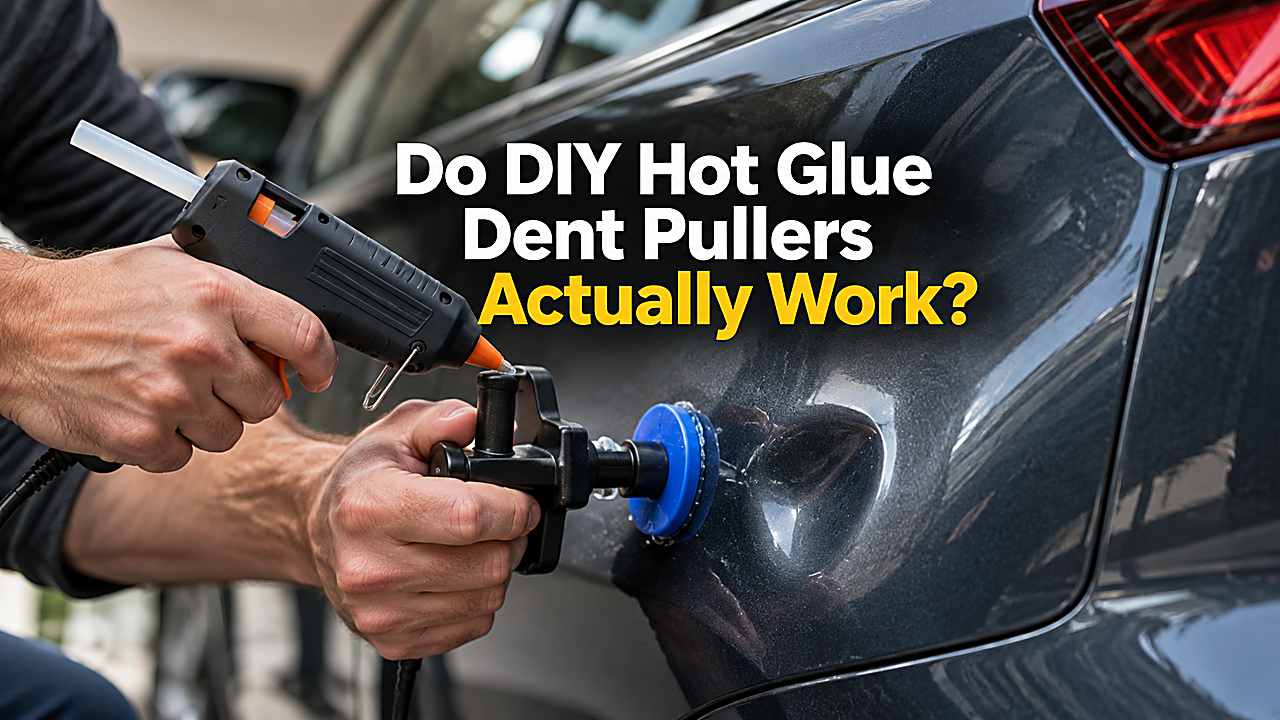
Yes, DIY hot-glue dent pullers can work on small, shallow dents when the factory paint is sound and the metal is not sharply creased or badly stretched. They work best when the pull tab matches the dent and you use several light controlled pulls rather than trying to yank the dent out once.
They are not universal. Repainted panels can release paint, sharp body-line dents need advanced finishing, and some consumer kits specifically exclude aluminum. If the paint is cracked or the dent is near a rigid edge, a professional PDR estimate is usually safer.
Hot-glue pullers are useful for favorable shallow dents, not complex collision damage. Clean the surface, match the tab to the low area, let the glue set, pull gradually and stop before you create a high spot.
Why glue pulling works
The adhesive temporarily bonds a plastic tab to the painted surface so a lifter, bridge or slide hammer can pull the metal outward without drilling or sanding. Professional PDR shops use sophisticated versions of this technique when backside access is limited. The difference is that technicians also manage crowns and high spots around the dent rather than simply pulling the center. A useful rule is to treat every finding as a reason for the next check rather than as a final verdict. When several independent clues point in the same direction, your confidence becomes much stronger.
The dents most likely to respond
Shallow round dings in open sheet metal
A smooth dent away from edges and strong body lines is the easiest target. Factory paint should be intact and the metal should not feel sharply folded.
Small parking dings can sometimes respond with only a few controlled pulls. Your final number should include the repair or ownership cost that will actually fall on you, not a generic internet average. Local labor rates, vehicle design and parts availability can change the economics quickly.
Larger soft dents can improve if the metal is not stretched
A larger dent is not automatically harder than a tiny sharp one. Soft broad displacement can have useful metal memory.
Work from the outer low areas toward the center rather than attaching one giant tab and pulling aggressively. A pre-purchase inspection remains one of the highest-value steps because it turns hidden uncertainty into a list you can price. Even experienced buyers use specialists when structure, electronics or drivetrain condition is difficult to judge.
The dents you should not learn on
Cracked, chipped or repainted surfaces
Glue can pull weak paint away from the substrate. Factory paint is generally the safer surface, but even factory coatings can be damaged if already chipped or compromised.
Repainted panels are a professional-risk decision. A pre-purchase inspection remains one of the highest-value steps because it turns hidden uncertainty into a list you can price. Even experienced buyers use specialists when structure, electronics or drivetrain condition is difficult to judge.
Sharp creases and body-line damage
These dents contain concentrated tension and often need knockdown work, rods and precise light-reading. Pulling only the center can create a row of high spots.
A cheap kit is not a substitute for PDR skill. Keep copies of photos, scan reports, quotes and key paperwork when the finding affects price. Clear documentation makes negotiation shorter and prevents memory from becoming less accurate after you have viewed several vehicles.
Resale matters too. A condition you are willing to accept today can still reduce the number of future buyers, dealer trade options or insurance choices, so include the exit value in the purchase decision.
Edges and double-wall structures
Metal near panel edges is stiff and often difficult to move. Strong pulls can stress paint without producing useful movement.
Get a professional opinion when the dent sits in a hem, rail or reinforced feature. Resale matters too. A condition you are willing to accept today can still reduce the number of future buyers, dealer trade options or insurance choices, so include the exit value in the purchase decision.
A controlled DIY glue-pull process
The most reliable way to use this section is to treat each check separately. One good sign should not cancel several bad ones, and one questionable sign should be verified before you assume the worst.
1. Clean and inspect the paint.
Wash the panel and remove wax or contamination from the tab area with the kit’s approved cleaner. Inspect for chips or clear-coat failure.
Do not use aggressive solvent that damages paint. Keep copies of photos, scan reports, quotes and key paperwork when the finding affects price. Clear documentation makes negotiation shorter and prevents memory from becoming less accurate after you have viewed several vehicles.
Resale matters too. A condition you are willing to accept today can still reduce the number of future buyers, dealer trade options or insurance choices, so include the exit value in the purchase decision.
2. Warm the working environment if the kit requires it.
Glue performance changes with temperature. Eastwood notes better results above roughly 60°F for its kit, while professional glues are sold in different temperature ranges. Do not overheat the panel.
Follow the glue manufacturer’s range. Resale matters too. A condition you are willing to accept today can still reduce the number of future buyers, dealer trade options or insurance choices, so include the exit value in the purchase decision.
3. Choose a tab that matches the low area.
A tab that is much larger than the dent can pull surrounding metal unnecessarily. Apply the specified hot glue and center the tab accurately.
Let it set for the time in the kit instructions. That distinction matters because the visible symptom is only one part of the decision. You should connect what you see with ownership records, service history, repair cost and what an independent inspection can verify.
4. Use a mini lifter or bridge before a slide hammer when possible.
A controlled lever or bridge gives you finer force than a hard slide-hammer hit. Increase force slowly. Stop after small movement and inspect reflections.
Multiple cautious pulls are safer than one large pull. A useful rule is to treat every finding as a reason for the next check rather than as a final verdict. When several independent clues point in the same direction, your confidence becomes much stronger.
5. Remove the tab with release agent and a plastic scraper.
Do not twist a bonded tab violently off the paint. Use the kit’s release agent or recommended alcohol and a nonmetal scraper. Clean residue, then inspect from several angles.
Repeat only if the panel is still low. Do not let a low asking price change the standard of proof you require. A cheap vehicle with unclear title, structural or mechanical risk can cost far more than a correctly priced car with honest cosmetic wear.
If the seller can document the explanation and the vehicle supports it, the issue may be manageable. If the story changes or inspection access is restricted, that uncertainty deserves real weight in your decision.
Why the first pull often does not finish the dent
PDR is a balance of lows and highs. Raising the center can reveal crowns around the perimeter that need to be tapped down before another pull. Consumer kits sometimes include knockdown tools for this reason.
If you cannot read the panel under reflection lighting, stop before chasing the dent into a larger wavy area. A pre-purchase inspection remains one of the highest-value steps because it turns hidden uncertainty into a list you can price. Even experienced buyers use specialists when structure, electronics or drivetrain condition is difficult to judge.
What the marketing does not tell you
Some consumer kits advertise paint-safe glue, but no adhesive method is risk-free on unknown refinishing or failing clear coat. Harbor Freight’s current Maddox kit manual also states that the kit will not repair all dents and specifically excludes aluminum surfaces. Read the instructions for your exact kit instead of assuming every glue system works on every panel. Keep copies of photos, scan reports, quotes and key paperwork when the finding affects price. Clear documentation makes negotiation shorter and prevents memory from becoming less accurate after you have viewed several vehicles.
When a professional PDR repair is cheaper in the long run
If the dent is on a high-value car, sharp body line, aluminum panel, repaired panel or visible central area, the cost of professional PDR may be less than correcting a DIY high spot or paint pull. Get a quote before experimenting. The best DIY candidate is a dent you can afford not to make worse. Resale matters too. A condition you are willing to accept today can still reduce the number of future buyers, dealer trade options or insurance choices, so include the exit value in the purchase decision.
Protect the original finish before chasing perfection
Factory paint has value, and a slightly visible ding is often cheaper to live with than a failed DIY repair that now needs refinishing. Make every correction reversible when possible, stop when the surface becomes unpredictable and get a professional quote before using stronger force. The best DIY result is controlled improvement without creating a new defect.
Keep copies of photos, scan reports, quotes and key paperwork when the finding affects price. Clear documentation makes negotiation shorter and prevents memory from becoming less accurate after you have viewed several vehicles.
Frequently Asked Questions
Glue pulling is simple enough to look foolproof in videos, but the difficult part is controlling panel tension and paint risk. These questions cover the limits most DIY kits do not explain well.
Can hot glue pull factory paint off?
It can, especially when the paint is chipped, aged, contaminated, overheated or poorly bonded. Sound factory paint is the preferred surface, but there is still risk. Use the recommended glue, temperature and release method.
Stop if the coating shows any lifting. A pre-purchase inspection remains one of the highest-value steps because it turns hidden uncertainty into a list you can price. Even experienced buyers use specialists when structure, electronics or drivetrain condition is difficult to judge.
Do glue dent pullers work on aluminum?
Professional technicians can use glue-pulling methods on aluminum, but some consumer kits explicitly exclude aluminum because the metal behaves differently and can be more difficult to control. Check your kit’s instructions.
An aluminum dent is a better job for an experienced PDR technician. Keep copies of photos, scan reports, quotes and key paperwork when the finding affects price. Clear documentation makes negotiation shorter and prevents memory from becoming less accurate after you have viewed several vehicles.
How long should PDR glue set before pulling?
Follow the glue manufacturer’s directions because temperature and formula change the set time. Some kits specify only a few minutes. Pulling too early reduces bond strength, while leaving certain glues too long can make removal harder.
Do not invent a longer cure time. Resale matters too. A condition you are willing to accept today can still reduce the number of future buyers, dealer trade options or insurance choices, so include the exit value in the purchase decision.
Is a slide hammer better than a bridge puller?
A slide hammer can deliver more force for deeper dents, while a bridge or mini lifter provides more controlled gradual lift. Beginners are less likely to overpull with a controlled lifter. Use only as much force as needed.
More force is not automatically more effective. That distinction matters because the visible symptom is only one part of the decision. You should connect what you see with ownership records, service history, repair cost and what an independent inspection can verify.
What if the dent becomes a high spot?
Stop pulling. A high spot needs controlled knockdown or professional finishing, not another outward pull. Repeated pulling can stretch the metal.
If you cannot read and level the surface, hand the repair to a PDR technician. A useful rule is to treat every finding as a reason for the next check rather than as a final verdict. When several independent clues point in the same direction, your confidence becomes much stronger.
Conclusion
The smartest approach to do diy hot glue dent pullers actually work is to start with the direct answer, then narrow uncertainty with inspection, documentation and real local pricing. That keeps a simple question from turning into an expensive assumption.
If the numbers and evidence still make sense after those checks, move forward confidently. If they do not, walking away or choosing the simpler repair is often the most profitable decision.