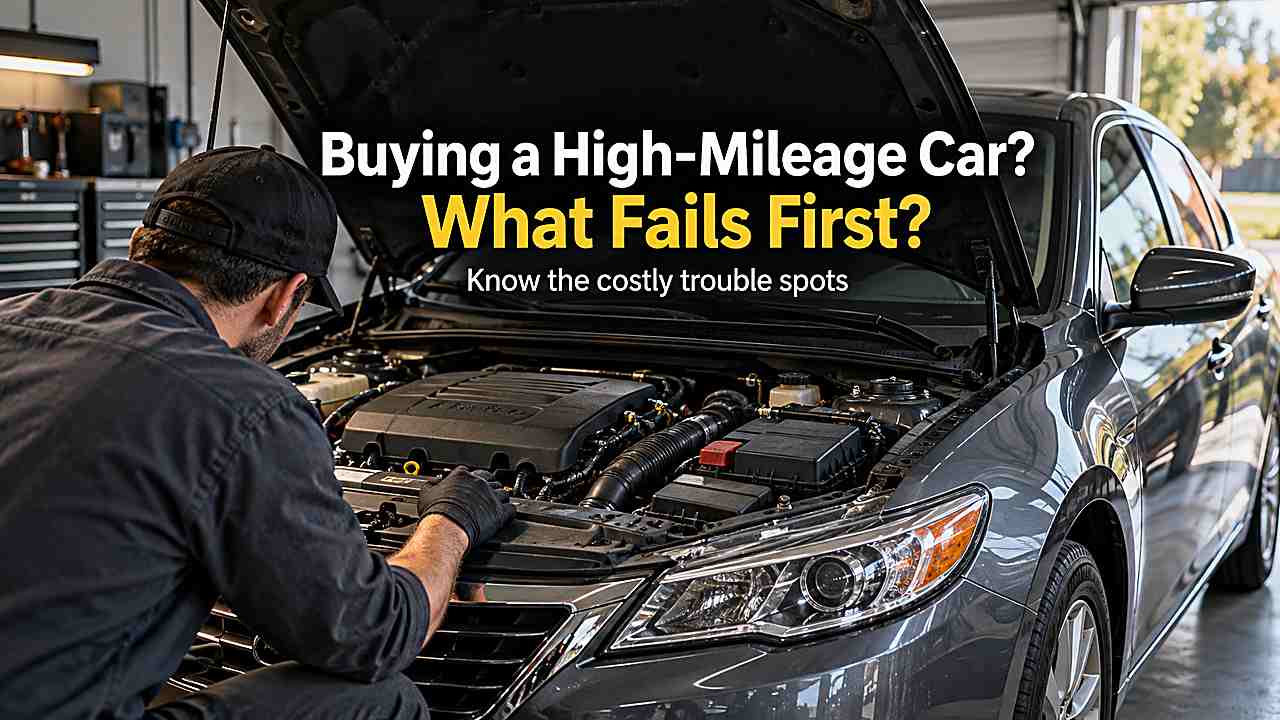
High mileage does not make a car automatically unreliable, but around and beyond 100,000 miles you should expect age-related maintenance and wear items to become more important. Common expensive needs include timing belts on engines that use them, water pumps, spark plugs, rubber hoses and mounts, suspension bushings and dampers, wheel bearings, alternators or starters, and transmission or clutch wear.
The order is not universal. A 140,000-mile highway car with complete maintenance can be a safer purchase than an 80,000-mile car that missed coolant, transmission and timing-belt service. Buy the maintenance history and current condition, not just the odometer number.
The first high-mileage costs are usually scheduled maintenance and wear components rather than sudden engine failure. Verify timing-belt or chain service, cooling system, transmission condition, suspension, brakes, leaks and rubber components before you buy.
The 100,000-mile maintenance cluster
The most reliable way to use this section is to treat each check separately. One good sign should not cancel several bad ones, and one questionable sign should be verified before you assume the worst.
Spark plugs and ignition service often arrive around this range
Many modern long-life spark plugs last close to 100,000 miles, though intervals vary by engine. Worn plugs can cause roughness, misfire and reduced efficiency. Coil packs may fail individually with age.
Check the manufacturer’s schedule rather than assuming the plugs were already done. Keep copies of photos, scan reports, quotes and key paperwork when the finding affects price. Clear documentation makes negotiation shorter and prevents memory from becoming less accurate after you have viewed several vehicles.
Resale matters too. A condition you are willing to accept today can still reduce the number of future buyers, dealer trade options or insurance choices, so include the exit value in the purchase decision.
Timing belts can turn a bargain into an engine-risk purchase
Engines that use a timing belt often require replacement at a defined mileage or age interval. If the belt breaks on an interference engine, internal engine damage can occur. Ask for an invoice, not a verbal claim.
Timing-chain engines have different service needs and should not be treated as maintenance-free automatically. Resale matters too. A condition you are willing to accept today can still reduce the number of future buyers, dealer trade options or insurance choices, so include the exit value in the purchase decision.
Water pumps and coolant-system parts deserve attention
Consumer Reports notes water pumps and rubber coolant parts among the significant maintenance items that can appear around high mileage. Look for coolant staining, low reservoir level, overheating history and old hoses.
Cooling problems can damage an otherwise healthy engine. That distinction matters because the visible symptom is only one part of the decision. You should connect what you see with ownership records, service history, repair cost and what an independent inspection can verify.
Suspension and steering wear becomes easier to feel than to see
Shocks and struts lose control gradually
A worn damper may not leak dramatically, yet the car can float, bounce or feel unsettled over rough pavement. Uneven tire wear can reveal alignment or suspension problems.
A mechanic can check play and leakage on a lift. Resale matters too. A condition you are willing to accept today can still reduce the number of future buyers, dealer trade options or insurance choices, so include the exit value in the purchase decision.
Bushings, ball joints and tie-rod ends age with time and impact
Rubber bushings crack and soften, while joints can develop play. Clunks, vague steering and uneven tire wear are common clues. Road quality can make a lower-mileage city car wear faster than a higher-mileage highway car.
Inspect condition, not just mileage. That distinction matters because the visible symptom is only one part of the decision. You should connect what you see with ownership records, service history, repair cost and what an independent inspection can verify.
Wheel bearings may begin humming or developing play
A failing bearing can sound like a speed-dependent hum or growl. Tire noise can imitate it. A lift inspection helps separate the causes.
Bearing replacement cost varies widely depending on hub design and labor. A useful rule is to treat every finding as a reason for the next check rather than as a final verdict. When several independent clues point in the same direction, your confidence becomes much stronger.
Drivetrain wear can be the expensive part of a high-mileage decision
The most reliable way to use this section is to treat each check separately. One good sign should not cancel several bad ones, and one questionable sign should be verified before you assume the worst.
Automatic transmissions can begin showing wear after 100,000 miles
Consumer Reports notes that automatic transmissions can show wear around this period, especially if fluid service was neglected or the model has known weaknesses. Test cold and hot. Look for slip, shudder and delayed engagement.
Service history matters more than fluid color alone. That distinction matters because the visible symptom is only one part of the decision. You should connect what you see with ownership records, service history, repair cost and what an independent inspection can verify.
Manual clutches are consumable components
Driving style has a huge effect on clutch life, so a 70,000-mile clutch can be worn while another lasts far longer. Check engagement, slip and noise. Replacing a clutch can involve significant labor.
Ask whether the clutch and flywheel have been replaced. A useful rule is to treat every finding as a reason for the next check rather than as a final verdict. When several independent clues point in the same direction, your confidence becomes much stronger.
CVTs and dual-clutch transmissions need model-specific research
High mileage alone cannot tell you how long these units will last. Some have strict fluid-service intervals and known failure patterns. Research the exact powertrain before viewing the car.
A generic statement that ‘CVTs are bad’ or ‘sealed means lifetime fluid’ is not useful. Do not let a low asking price change the standard of proof you require. A cheap vehicle with unclear title, structural or mechanical risk can cost far more than a correctly priced car with honest cosmetic wear.
If the seller can document the explanation and the vehicle supports it, the issue may be manageable. If the story changes or inspection access is restricted, that uncertainty deserves real weight in your decision.
Engine accessories fail with age even when the engine itself is healthy
Starters, alternators, engine mounts, belt tensioners and accessory bearings often become repair items as mileage and years accumulate. Listen for squeals and rattles, check charging-system voltage and watch for excessive engine movement. These repairs are usually less catastrophic than internal engine failure, but several at once can change the economics of the car. Resale matters too. A condition you are willing to accept today can still reduce the number of future buyers, dealer trade options or insurance choices, so include the exit value in the purchase decision.
Oil leaks and rubber seals deserve a lift inspection
Valve-cover and oil-pan leaks are common age-related repairs
A small seep may be manageable, while an active leak onto exhaust components or a low oil level needs attention. Clean engines can hide recent leakage, so inspect after the test drive.
Ask about oil consumption between changes. Do not let a low asking price change the standard of proof you require. A cheap vehicle with unclear title, structural or mechanical risk can cost far more than a correctly priced car with honest cosmetic wear.
If the seller can document the explanation and the vehicle supports it, the issue may be manageable. If the story changes or inspection access is restricted, that uncertainty deserves real weight in your decision.
Axle boots and driveline seals are easy to miss
A torn CV boot can throw grease around the suspension and eventually damage the joint. Differential and transfer-case seals also age. AWD vehicles have more driveline components to inspect.
A mechanic can identify whether a leak is cosmetic seepage or an urgent repair. If the seller can document the explanation and the vehicle supports it, the issue may be manageable. If the story changes or inspection access is restricted, that uncertainty deserves real weight in your decision.
High mileage is easier to buy when the records are boring
Regular oil changes, coolant service, transmission fluid, brake fluid, belts, plugs and major scheduled maintenance are exactly the boring paperwork you want to see. A thick record file reduces uncertainty. No records do not prove neglect, but they force you to price more risk into the purchase. A useful rule is to treat every finding as a reason for the next check rather than as a final verdict. When several independent clues point in the same direction, your confidence becomes much stronger.
A pre-purchase inspection matters more as mileage rises
A high-mileage car can still be an excellent value if compression, cooling, transmission, suspension, brakes and structure are sound. Pay for a mechanic to put it on a lift and scan the modules. The inspection cost is small compared with one missed overheating or transmission problem. Do not let a low asking price change the standard of proof you require. A cheap vehicle with unclear title, structural or mechanical risk can cost far more than a correctly priced car with honest cosmetic wear.
Use the finding to decide your next step, not just your opinion
When a test reveals a concern, convert it into an action: request a record, get a repair quote, scan the vehicle, compare another example or pay for an independent inspection. This keeps the buying decision evidence-based. You do not need to diagnose every problem yourself to make a smart purchase.
A useful rule is to treat every finding as a reason for the next check rather than as a final verdict. When several independent clues point in the same direction, your confidence becomes much stronger.
Frequently Asked Questions
High-mileage cars fail in patterns, but maintenance history can move those patterns earlier or later by tens of thousands of miles. These questions focus on the items that change purchase risk the most.
Is 100,000 miles too high to buy a used car?
No. Many modern vehicles can travel well beyond 100,000 miles when maintained properly. The issue is that expensive maintenance and wear items become more likely.
Research the model, inspect it and budget realistically. That distinction matters because the visible symptom is only one part of the decision. You should connect what you see with ownership records, service history, repair cost and what an independent inspection can verify.
What is the most expensive high-mileage failure?
Transmission, engine internal damage and certain AWD or hybrid-system failures can be among the largest costs, but the exact risk is model-specific. A neglected cooling system can also destroy an otherwise good engine.
Look at known reliability patterns for the exact powertrain. A useful rule is to treat every finding as a reason for the next check rather than as a final verdict. When several independent clues point in the same direction, your confidence becomes much stronger.
Should you avoid a high-mileage turbocharged car?
Not automatically. Turbochargers add heat and mechanical complexity, so oil-change history and cooling condition are especially important. Check for smoke, boost faults and oil leaks.
A well-maintained turbo car can be preferable to a neglected naturally aspirated one. Do not let a low asking price change the standard of proof you require. A cheap vehicle with unclear title, structural or mechanical risk can cost far more than a correctly priced car with honest cosmetic wear.
Do high-mileage cars always burn oil?
No. Some engines use little oil even at high mileage, while others develop consumption earlier because of design, wear or poor maintenance. Ask the seller how much oil is added between changes.
Check for smoke and leaks. Research model-specific oil-consumption issues. If the seller can document the explanation and the vehicle supports it, the issue may be manageable. If the story changes or inspection access is restricted, that uncertainty deserves real weight in your decision.
How much repair money should you reserve for a high-mileage car?
There is no universal amount because vehicle complexity and existing maintenance differ. Build a reserve around known upcoming services and one or two plausible repairs. A pre-purchase inspection helps turn unknowns into a realistic budget.
If you cannot absorb a significant repair, buy a lower-risk vehicle. Your final number should include the repair or ownership cost that will actually fall on you, not a generic internet average. Local labor rates, vehicle design and parts availability can change the economics quickly.
Conclusion
For buying a high mileage car what parts fail first, the main answer is useful only when you connect it to the actual vehicle, paperwork or tool in front of you. Verify the details that can change safety, legality or repair cost before you commit money.
If the numbers and evidence still make sense after those checks, move forward confidently. If they do not, walking away or choosing the simpler repair is often the most profitable decision.