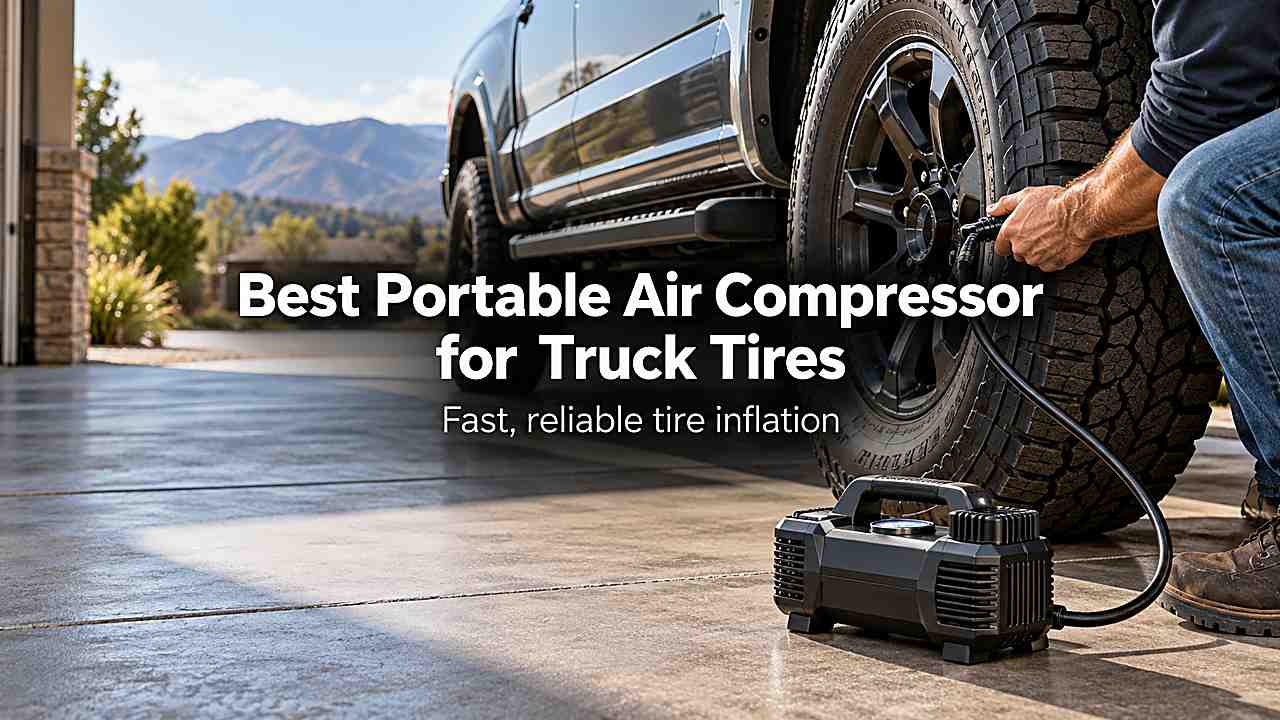
For most stock or mildly modified trucks, the VIAIR 88P is one of the best portable 12-volt compressors because it is compact, connects directly to the battery and is rated for tires up to 33 inches. If you regularly air down larger off-road tires, you should step up to a higher-output compressor rather than judging inflators by maximum PSI alone.
The right compressor depends on tire volume, not just pressure. A truck tire at 35 PSI contains far more air than a passenger-car tire at the same pressure, so airflow, duty cycle, hose reach and power connection matter more than a flashy pressure rating.
Choose by tire size and airflow first. The VIAIR 88P is a strong all-around pick for truck tires up to 33 inches, while larger off-road tires benefit from a higher-CFM compressor with a longer duty cycle.
What makes a truck-tire inflator different from a car inflator
Truck tires need more air volume, especially on half-ton pickups, SUVs and off-road builds. A tiny cigarette-lighter inflator may eventually reach the target pressure but can overheat or take too long.
You want a compressor that can run long enough to inflate several tires without thermal shutdown. That detail matters because it changes how safely and efficiently the job can be completed. You should choose the tool or method around the actual vehicle and working conditions rather than a headline specification.
What this means for your setup
Good preparation also reduces the amount of expensive equipment you need. Clean surfaces, correct access and a clear workflow often matter more than buying the most powerful version of every tool. When safety is involved, manufacturer procedures and rated equipment take priority over internet shortcuts. Saving a few minutes is never worth creating a lifting, electrical or braking hazard.
Best overall for most truck owners
VIAIR’s current 88P is rated for tires up to 33 inches, delivers about 1.97 CFM at 0 PSI and draws up to 20 amps from the battery. The direct-battery clamps avoid the limits of many 12-volt accessory sockets.
It is a practical match for stock pickups, overland SUVs and emergency use without becoming bulky. A controlled process is usually faster in the end because it prevents rework. If one step begins behaving differently from what you expect, stop and inspect before adding more force, heat, pressure or chemical strength.
When to choose a larger compressor
If your truck runs 35-inch or larger tires, you frequently air down to the teens off road, or you want to refill all four tires quickly, move to a higher-CFM model. Bigger compressors cost and weigh more, but repeated long fills are exactly where they earn the difference.
Good preparation also reduces the amount of expensive equipment you need. Clean surfaces, correct access and a clear workflow often matter more than buying the most powerful version of every tool.
Features that matter in real use
Look for a long hose that reaches the rear tire from your chosen power point, a readable gauge, adequate duty cycle, a carry bag and replacement chuck options. Battery-clamp power is useful for higher-current compressors.
Cord length should be considered with the wheelbase of your truck. Think about storage and repeat use as well as the immediate job. A product that works perfectly once but is awkward to store, service or replace can become a poor home-garage choice over time.
What this means for your setup
Your best result comes from matching capacity to the task with some margin. Running tools continuously at their limit creates heat, wear and frustration even when the specification says the job is technically possible. A controlled process is usually faster in the end because it prevents rework. If one step begins behaving differently from what you expect, stop and inspect before adding more force, heat, pressure or chemical strength.
How to use a portable compressor without overheating it
Check the compressor’s duty-cycle guidance before running it continuously. Keep the unit on a stable surface with airflow around it and avoid placing a hot compressor on dry grass or plastic trim. Let the unit cool when required by the manual.
The hose and fittings can become very hot during use. When safety is involved, manufacturer procedures and rated equipment take priority over internet shortcuts. Saving a few minutes is never worth creating a lifting, electrical or braking hazard.
A simple truck-tire inflation routine
Measure pressure cold when possible, connect the compressor securely, inflate in short checks and confirm with a separate gauge if accuracy matters. Do not chase sidewall maximum pressure.
Use the vehicle placard for normal road pressure unless your tire, load or off-road setup calls for a different manufacturer-approved value. Your best result comes from matching capacity to the task with some margin. Running tools continuously at their limit creates heat, wear and frustration even when the specification says the job is technically possible.
What to carry with the compressor
A plug kit, valve-core tool, accurate gauge, gloves, flashlight and spare valve caps turn the inflator into a useful roadside kit. For off-road travel, add a tire deflator and recovery equipment.
The compressor solves low pressure, not a damaged sidewall or unsafe tire. That detail matters because it changes how safely and efficiently the job can be completed. You should choose the tool or method around the actual vehicle and working conditions rather than a headline specification.
What this means for your setup
Good preparation also reduces the amount of expensive equipment you need. Clean surfaces, correct access and a clear workflow often matter more than buying the most powerful version of every tool. When safety is involved, manufacturer procedures and rated equipment take priority over internet shortcuts. Saving a few minutes is never worth creating a lifting, electrical or braking hazard.
How to choose without overspending
A controlled process is usually faster in the end because it prevents rework. If one step begins behaving differently from what you expect, stop and inspect before adding more force, heat, pressure or chemical strength. Think about storage and repeat use as well as the immediate job. A product that works perfectly once but is awkward to store, service or replace can become a poor home-garage choice over time.
Direct-battery clamps are useful for higher-output inflators
Truck-oriented compressors often draw more current than a standard accessory socket can safely provide. Direct battery clamps let the compressor use a properly rated circuit without overloading the dashboard outlet. Connect with the engine off unless the manufacturer tells you otherwise, observe polarity and route the cable away from belts, fans and hot exhaust components.
If the compressor manual recommends running the engine during extended inflation to protect the battery, make sure the vehicle is outside with adequate ventilation. Never run the engine in a closed garage. The compressor should sit where its cooling vents remain unobstructed.
Airflow at working pressure matters more than free-flow CFM
Manufacturers often publish airflow at 0 PSI because it is the largest number, but a tire is never inflated at zero pressure for long. As backpressure rises, compressor output falls. If you compare two inflators for large truck tires, look for an inflation chart or airflow at realistic pressure instead of assuming the larger free-flow CFM will always be faster. This is especially important when you regularly refill from 15 to 35 PSI after trail driving.
You should also consider how many tires you expect to fill in one session. A compressor that is fine for topping up one tire can become frustrating when four 35-inch tires need significant air. Heat buildup and duty cycle become part of performance, not just convenience.
A roadside compressor should be easy to use in bad conditions
Nighttime shoulder repairs and bad weather make small design details more important. A carry bag keeps the hose, chuck and power leads together, while a lighted or easy-to-read gauge reduces guesswork. Gloves help with hot fittings, and reflective clothing is worth carrying if you may need to work near traffic. The safest roadside inflation is still one performed well away from moving vehicles whenever possible.
Test the compressor at home before relying on it for travel. Inflate one truck tire from a deliberately reduced pressure, verify the cable reaches every wheel and learn how hot the hose becomes. A ten-minute practice session reveals storage, reach and heat problems before they become roadside surprises.
Why a separate tire gauge is still worth carrying
Built-in compressor gauges are convenient, but a separate quality gauge gives you a useful cross-check when pressure matters. Check final pressure after the compressor has been disconnected and the tire has had a moment to settle. This is especially useful when you air down for trails and then return to highway pressure, where a few PSI can affect ride, heat and tire wear. Keeping one dedicated gauge in the compressor bag also prevents you from relying on an unknown gauge at a fuel station.
Frequently Asked Questions
Truck-tire compressors are often marketed by maximum PSI, but speed, heat and tire volume are what determine whether you will actually like using one.
How much PSI should a truck tire compressor have?
Maximum PSI only needs to exceed the pressure you actually use. Most truck tires operate far below 100 PSI unless you are dealing with certain heavy-duty load applications. Airflow and duty cycle usually matter more.
Match the compressor to the vehicle and tire specification. Good preparation also reduces the amount of expensive equipment you need. Clean surfaces, correct access and a clear workflow often matter more than buying the most powerful version of every tool.
Is a cordless inflator good enough for truck tires?
It can be excellent for topping off stock truck tires, especially if you already own the battery platform. Repeatedly filling large aired-down off-road tires can drain batteries quickly and take longer.
For that job, a high-output direct-battery compressor is often better. Think about storage and repeat use as well as the immediate job. A product that works perfectly once but is awkward to store, service or replace can become a poor home-garage choice over time.
Can you run a 12-volt compressor from the cigarette lighter?
Only if the compressor is designed for the socket’s current limit. Higher-output units often use battery clamps because accessory circuits may be fused at 10 to 15 amps. Never fit a larger fuse just to run a compressor.
Use the connection method specified by the manufacturer. When safety is involved, manufacturer procedures and rated equipment take priority over internet shortcuts. Saving a few minutes is never worth creating a lifting, electrical or braking hazard.
How long should it take to inflate a truck tire?
It depends on tire size, starting pressure and compressor airflow. Topping up from 30 to 35 PSI can take only a short time, while filling a large off-road tire from a low trail pressure can take several minutes.
Manufacturer inflation charts are more useful than a generic time estimate. Your best result comes from matching capacity to the task with some margin. Running tools continuously at their limit creates heat, wear and frustration even when the specification says the job is technically possible.
Should you keep the compressor inside the truck all year?
Yes, if the manufacturer permits the storage temperature range and the unit is secured so it cannot become a projectile. Keep it dry and periodically test it. Inspect the hose and wiring for heat or age damage.
A compressor you have not tested in two years is not an emergency plan. That detail matters because it changes how safely and efficiently the job can be completed. You should choose the tool or method around the actual vehicle and working conditions rather than a headline specification.
Conclusion
Choose by tire size and airflow first. The VIAIR 88P is a strong all-around pick for truck tires up to 33 inches, while larger off-road tires benefit from a higher-CFM compressor with a longer duty cycle. The safest and most cost-effective result comes from choosing capacity and technique for the real job rather than buying or using more than the situation requires.
If the vehicle, tool or procedure falls outside what you can verify confidently, use the manufacturer’s service information or a qualified technician. Good garage work is repeatable, controlled and safe.