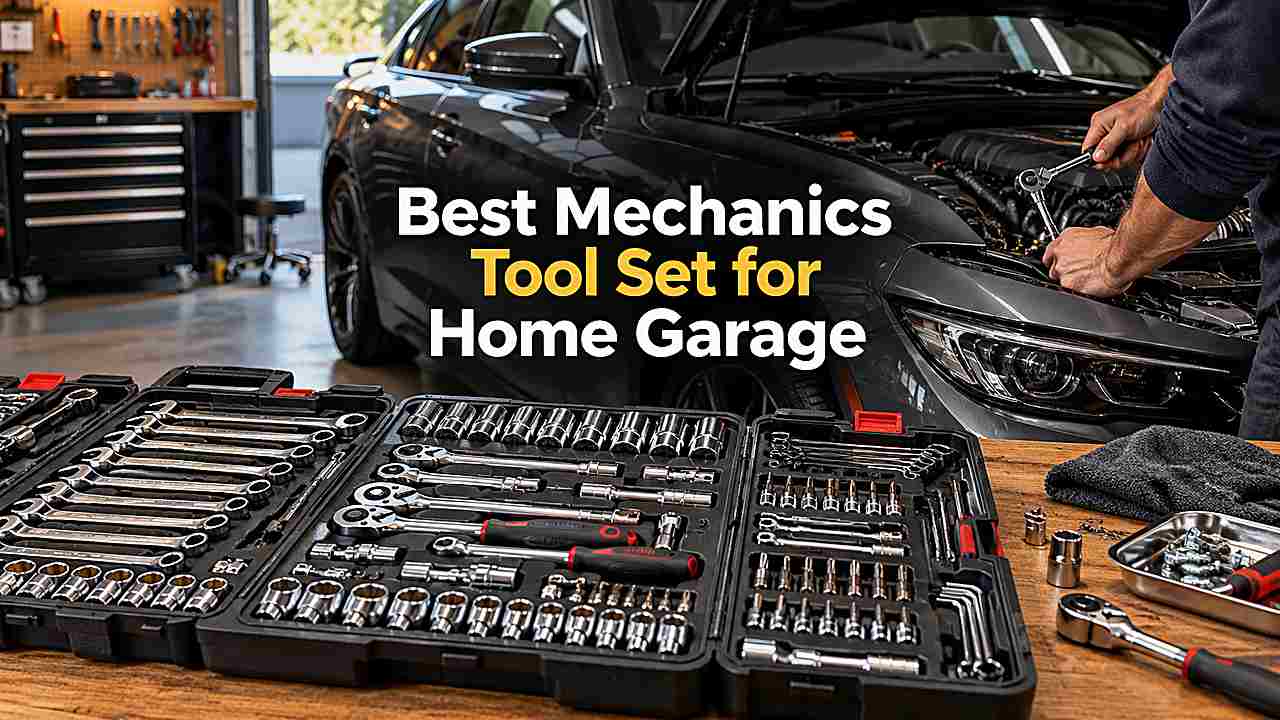
For a serious home garage, the GEARWRENCH 239-piece 80942 is one of the strongest complete sets because it includes extensive socket coverage, three drive sizes, long-pattern wrenches and 90-tooth ratchets. DEWALT’s 247-piece set is a better value-oriented alternative when you want broad home-mechanic coverage in one case.
Do not choose a mechanic set by piece count alone. A 300-piece kit padded with driver bits can be less useful than a 200-piece kit with deep sockets, 1/2-inch drive tools and the metric sizes your vehicles actually use.
GEARWRENCH 80942 is the best complete set for a home mechanic who wants a long-term kit; DEWALT 247-piece is the better value choice. Prioritize socket coverage, drive sizes and ratchet quality over raw piece count.
What a home-garage set needs to cover
You want 1/4-, 3/8- and 1/2-inch drives, shallow and deep metric sockets, useful SAE coverage if you work on older domestic vehicles, spark-plug sockets, extensions, combination wrenches and durable ratchets. A set that stops at 3/8-inch drive can become limiting once you work on wheels or suspension.
When safety is involved, manufacturer procedures and rated equipment take priority over internet shortcuts. Saving a few minutes is never worth creating a lifting, electrical or braking hazard.
Best overall: GEARWRENCH 80942
The 239-piece set includes a very broad socket selection, three 90-tooth ratchets and long-pattern combination wrenches in a drawer-style case. It costs more than basic big-box sets, but the contents are focused on real mechanical work.
It is a good fit if you expect to keep expanding your garage around the set. Your best result comes from matching capacity to the task with some margin. Running tools continuously at their limit creates heat, wear and frustration even when the specification says the job is technically possible.
Best value: DEWALT 247-piece mechanics set
DEWALT’s 247-piece set covers all three common drive sizes and includes both metric and SAE sockets with a portable molded case. It is useful for a homeowner who wants one comprehensive starter set.
You can add specialty sockets and better wrenches later. That detail matters because it changes how safely and efficiently the job can be completed. You should choose the tool or method around the actual vehicle and working conditions rather than a headline specification.
What this means for your setup
Good preparation also reduces the amount of expensive equipment you need. Clean surfaces, correct access and a clear workflow often matter more than buying the most powerful version of every tool. When safety is involved, manufacturer procedures and rated equipment take priority over internet shortcuts. Saving a few minutes is never worth creating a lifting, electrical or braking hazard.
What CRAFTSMAN still does well
CRAFTSMAN remains attractive for home mechanics because replacement availability and warranty support are easy to access in many areas. Their larger VERSASTACK-style sets are useful when you want organized drawers instead of one heavy clamshell case.
Compare actual socket sizes before buying. A controlled process is usually faster in the end because it prevents rework. If one step begins behaving differently from what you expect, stop and inspect before adding more force, heat, pressure or chemical strength.
Six-point sockets are the better default
Six-point sockets contact more of a fastener’s flat surfaces and are less likely to round stubborn automotive bolts than 12-point sockets. Twelve-point tools still have their place on specific fasteners.
A set heavy on six-point metric sockets is ideal for modern car work. Good preparation also reduces the amount of expensive equipment you need. Clean surfaces, correct access and a clear workflow often matter more than buying the most powerful version of every tool.
Ratchet tooth count affects access, not torque capacity
Fine-tooth ratchets need less handle movement between clicks, which helps in engine bays and tight interiors. That does not mean you should use a small ratchet as a breaker bar.
Use a breaker bar for stubborn high-torque fasteners. Think about storage and repeat use as well as the immediate job. A product that works perfectly once but is awkward to store, service or replace can become a poor home-garage choice over time.
What this means for your setup
Your best result comes from matching capacity to the task with some margin. Running tools continuously at their limit creates heat, wear and frustration even when the specification says the job is technically possible. A controlled process is usually faster in the end because it prevents rework. If one step begins behaving differently from what you expect, stop and inspect before adding more force, heat, pressure or chemical strength.
The missing tools you should budget separately
No mechanic set replaces a torque wrench, breaker bar, pliers, screwdrivers, pry tools, multimeter, OBD2 scanner or safe lifting equipment. Leave room in the budget for those essentials.
A perfect socket set cannot safely lift a vehicle. When safety is involved, manufacturer procedures and rated equipment take priority over internet shortcuts. Saving a few minutes is never worth creating a lifting, electrical or braking hazard.
A portable case versus a rolling drawer
Cases are excellent if you work in the driveway or move tools between locations. Drawer sets are better when the tools live permanently in the garage.
Consider how often you will transport the set before choosing a 70-pound case. Your best result comes from matching capacity to the task with some margin. Running tools continuously at their limit creates heat, wear and frustration even when the specification says the job is technically possible.
Buy replacement sizes individually instead of replacing the set
The first lost 10mm socket does not mean the kit failed. Good tool brands sell individual sockets and ratchets.
Build around a strong core set and replace or upgrade frequently used pieces as your repair work grows. That detail matters because it changes how safely and efficiently the job can be completed. You should choose the tool or method around the actual vehicle and working conditions rather than a headline specification.
What this means for your setup
Good preparation also reduces the amount of expensive equipment you need. Clean surfaces, correct access and a clear workflow often matter more than buying the most powerful version of every tool. When safety is involved, manufacturer procedures and rated equipment take priority over internet shortcuts. Saving a few minutes is never worth creating a lifting, electrical or braking hazard.
How to make the setup easier to repeat
Your best result comes from matching capacity to the task with some margin. Running tools continuously at their limit creates heat, wear and frustration even when the specification says the job is technically possible. A controlled process is usually faster in the end because it prevents rework. If one step begins behaving differently from what you expect, stop and inspect before adding more force, heat, pressure or chemical strength.
Keep torque tools separate from general mechanic sets
Most large sets do not include a proper torque wrench, and that is a tool you should buy separately. Wheel lugs, caliper brackets, drain plugs and engine fasteners have specified torque values. A breaker bar loosens stubborn fasteners; a torque wrench finishes them accurately.
Store click-type torque wrenches according to the manufacturer’s instructions and do not use them as breaker bars. Calibration and careful storage matter more than adding another hundred pieces to the main kit.
Build around serviceability and replacement availability
A good home set should be easy to expand when you lose a 10mm socket or need a longer ratchet. Brands with widely available individual sockets and lifetime hand-tool warranties are easier to live with than one-off kits that cannot be matched later. Check whether the storage case has labeled positions and whether replacement sizes fit the original tray.
Do not let a warranty substitute for tool quality. A tool that rounds a fastener at midnight is inconvenient even if replacement is free. Spend more on the ratchets, sockets and wrenches you use constantly and save on rarely used accessories.
A good starter set should leave room for specialty upgrades
Automotive work quickly branches into Torx, E-Torx, hex, triple-square and other specialty fasteners depending on the vehicles you own. Do not reject a strong core set because it lacks every specialty bit. It is often better to add one quality specialty rail when the need appears than to buy a huge kit full of rarely used pieces.
Keep a running list of tools you had to borrow or improvise during jobs. If the same missing tool appears twice, it probably deserves a permanent place in your garage. That creates a personalized tool set instead of one designed by marketing.
Match storage to the way you actually work
A large molded case is convenient until you start using the set every weekend. If the case must be opened on the floor, transferring the most-used sockets and ratchets to a drawer cart can improve workflow while keeping the original case for backup and transport. Do not throw the case away immediately because labeled slots make missing tools obvious. Over time, let your storage system evolve around the repairs you perform most often.
Frequently Asked Questions
Large mechanic sets can look impressive while still missing the exact tools automotive work needs. These questions focus on buying useful coverage rather than maximum piece count.
How many pieces should a good mechanics tool set have?
Piece count is secondary. Roughly 150 to 250 well-chosen pieces can cover more real work than a 300-piece kit full of bits and hex keys. Check the socket-size chart.
You want minimal gaps in common metric sizes. That detail matters because it changes how safely and efficiently the job can be completed. You should choose the tool or method around the actual vehicle and working conditions rather than a headline specification.
Do you need SAE tools for modern cars?
Many modern vehicles are overwhelmingly metric, but SAE tools are useful for older American vehicles, aftermarket accessories and general garage work. If you only maintain late-model imports, prioritize metric coverage.
A combined set gives flexibility. A controlled process is usually faster in the end because it prevents rework. If one step begins behaving differently from what you expect, stop and inspect before adding more force, heat, pressure or chemical strength.
Should a beginner buy impact sockets immediately?
Not unless you already own or plan to buy an impact wrench. Chrome hand sockets should not be used with impact tools.
When you add an impact, buy a separate impact-rated set in the sizes you use most. Good preparation also reduces the amount of expensive equipment you need. Clean surfaces, correct access and a clear workflow often matter more than buying the most powerful version of every tool.
Is GearWrench better than Craftsman for home mechanics?
GEARWRENCH tends to offer more enthusiast- and professional-oriented ratchets and wrench sets, while CRAFTSMAN is attractive for accessibility and warranty support. Both can work well at home.
Compare the specific set contents rather than choosing only by brand. Think about storage and repeat use as well as the immediate job. A product that works perfectly once but is awkward to store, service or replace can become a poor home-garage choice over time.
What drive size should you use most often?
3/8-inch drive is the general-purpose size for many automotive jobs. Use 1/4-inch for small fasteners and tight spaces, and 1/2-inch for larger higher-torque work.
A complete home-garage kit benefits from all three. When safety is involved, manufacturer procedures and rated equipment take priority over internet shortcuts. Saving a few minutes is never worth creating a lifting, electrical or braking hazard.
Conclusion
GEARWRENCH 80942 is the best complete set for a home mechanic who wants a long-term kit; DEWALT 247-piece is the better value choice. Prioritize socket coverage, drive sizes and ratchet quality over raw piece count. The safest and most cost-effective result comes from choosing capacity and technique for the real job rather than buying or using more than the situation requires.
If the vehicle, tool or procedure falls outside what you can verify confidently, use the manufacturer’s service information or a qualified technician. Good garage work is repeatable, controlled and safe.