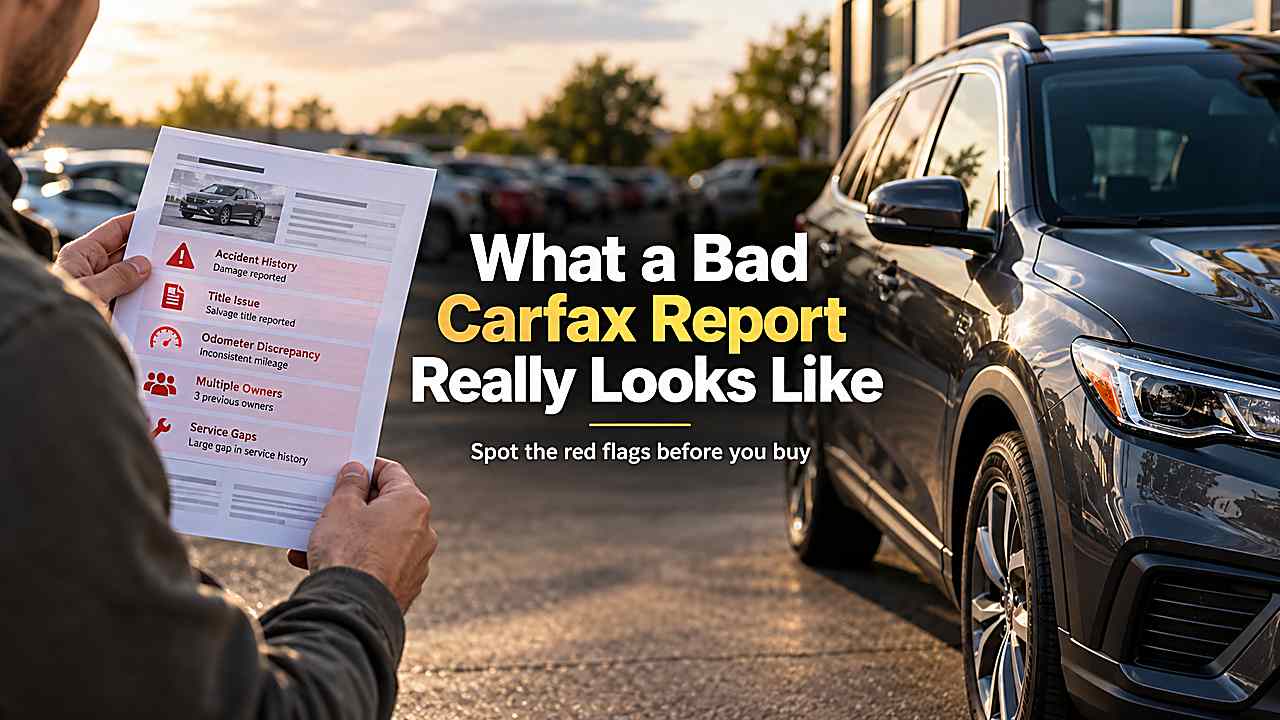
A bad CARFAX report is not one with any accident entry at all. The strongest red flags are salvage or rebuilt title brands, total-loss history, flood or fire branding, structural damage, airbag deployment, major or repeated accidents, odometer inconsistencies, lemon or buyback history, and ownership or service patterns that do not make sense.
A minor damage entry with consistent mileage and good maintenance can be much less concerning than a clean-looking report with unexplained gaps. CARFAX itself says not every accident or repair is reported, so the report should guide an inspection rather than replace one.
Focus first on title brands, total loss, structural damage, flood history, airbag deployment and mileage discrepancies. Then read the timeline for repeated damage, neglected maintenance or ownership patterns that need explanation.
Red flag number one: title brands and total-loss history
CARFAX reports can include salvage, junk, flood, lemon and other branded-title information. These entries affect value and may change insurance, financing and resale. A rebuilt car can still be roadworthy, but the report tells you to verify the original damage and repair quality.
Do not compare a branded-title car to clean-title pricing. Keep copies of photos, scan reports, quotes and key paperwork when the finding affects price. Clear documentation makes negotiation shorter and prevents memory from becoming less accurate after you have viewed several vehicles.
Red flag number two: structural damage or airbag deployment
Structural damage deserves a collision-repair inspection
A report may note structural damage or damage severe enough to affect unibody or frame components. That does not tell you whether the repair was good.
Ask for repair invoices and pre-repair photos, then use an independent collision-aware inspection. A useful rule is to treat every finding as a reason for the next check rather than as a final verdict. When several independent clues point in the same direction, your confidence becomes much stronger.
Airbag deployment raises the stakes
A deployed airbag means the crash involved enough force to trigger the restraint system. Verify that airbags, pretensioners and warning systems were properly restored. A clean dashboard light alone is not proof.
Enhanced diagnostics and physical inspection are appropriate. Do not let a low asking price change the standard of proof you require. A cheap vehicle with unclear title, structural or mechanical risk can cost far more than a correctly priced car with honest cosmetic wear.
If the seller can document the explanation and the vehicle supports it, the issue may be manageable. If the story changes or inspection access is restricted, that uncertainty deserves real weight in your decision.
Red flag number three: flood or water damage
Flood history can create long-term electrical corrosion, interior contamination and mechanical problems even after the car is cleaned. A flood-branded title is an obvious warning, but unreported water damage can exist on a clean report. Use the history to target a physical inspection for silt, corrosion and electrical faults. That distinction matters because the visible symptom is only one part of the decision. You should connect what you see with ownership records, service history, repair cost and what an independent inspection can verify.
Red flag number four: mileage that moves backward or becomes inconsistent
A single typo should be investigated, not automatically labeled fraud
Service shops and registration systems can enter mileage incorrectly. Look for whether the surrounding records support a clerical mistake.
A repeated pattern of higher readings followed by lower ones is far more concerning. If the seller can document the explanation and the vehicle supports it, the issue may be manageable. If the story changes or inspection access is restricted, that uncertainty deserves real weight in your decision.
Odometer branding or rollback indicators materially affect value
CARFAX reports can include odometer readings and problems reported by title or other sources. If the report says not actual mileage or shows a rollback concern, treat the car as a mileage-uncertain vehicle.
Verify with title records and service history before buying. Your final number should include the repair or ownership cost that will actually fall on you, not a generic internet average. Local labor rates, vehicle design and parts availability can change the economics quickly.
Red flag number five: repeated accident history
One minor parking-lot incident is different from several damage events across multiple years. Repeated collisions can mean more panels have been refinished, more alignment work has been performed and more future resale discount applies. Read each event’s location and severity when available.
The pattern matters more than the word accident by itself. Do not let a low asking price change the standard of proof you require. A cheap vehicle with unclear title, structural or mechanical risk can cost far more than a correctly priced car with honest cosmetic wear.
The timeline matters as much as the headline alerts
Rapid resale after a major damage event deserves questions
A car that was damaged, repaired and sold quickly may have been professionally restored, or it may have been flipped with minimal work. Compare dates of accident, auction, title changes and later service.
Ask who repaired it. A pre-purchase inspection remains one of the highest-value steps because it turns hidden uncertainty into a list you can price. Even experienced buyers use specialists when structure, electronics or drivetrain condition is difficult to judge.
Long service gaps can indicate missing data or missing maintenance
CARFAX can show service records, but not every repair shop reports. A three-year gap is not proof the car was neglected. It does mean you should ask for maintenance receipts and inspect consumables.
Missing information is an uncertainty, not automatically a negative fact. Keep copies of photos, scan reports, quotes and key paperwork when the finding affects price. Clear documentation makes negotiation shorter and prevents memory from becoming less accurate after you have viewed several vehicles.
Resale matters too. A condition you are willing to accept today can still reduce the number of future buyers, dealer trade options or insurance choices, so include the exit value in the purchase decision.
What a ‘good’ accident report can look like
A vehicle can have one minor damage event, no structural or airbag entry, consistent mileage, regular service and years of normal ownership afterward. That car may be perfectly reasonable when a physical inspection confirms good repair. CARFAX itself notes that damage severity matters.
Do not reject a good vehicle solely because the report is not spotless. Your final number should include the repair or ownership cost that will actually fall on you, not a generic internet average. Local labor rates, vehicle design and parts availability can change the economics quickly.
What CARFAX cannot tell you
CARFAX says its report is based on information supplied to it and not every accident or repair is reported. It cannot certify frame alignment, current engine health or quality of every body repair. Always combine the report with a test drive and pre-purchase inspection.
A clean report is useful history, not a warranty. A pre-purchase inspection remains one of the highest-value steps because it turns hidden uncertainty into a list you can price. Even experienced buyers use specialists when structure, electronics or drivetrain condition is difficult to judge.
Use the finding to decide your next step, not just your opinion
When a test reveals a concern, convert it into an action: request a record, get a repair quote, scan the vehicle, compare another example or pay for an independent inspection. This keeps the buying decision evidence-based. You do not need to diagnose every problem yourself to make a smart purchase.
If the seller can document the explanation and the vehicle supports it, the issue may be manageable. If the story changes or inspection access is restricted, that uncertainty deserves real weight in your decision.
Service history can reveal risk even without an accident entry
Repeated oil services and scheduled maintenance are reassuring, while a history dominated by auction events and ownership changes with little service documentation leaves more uncertainty. That does not prove neglect because many shops do not report to CARFAX. Ask the seller for receipts and compare the car’s current mechanical condition with the missing record period.
Also watch for expensive systems appearing repeatedly in the service timeline, such as cooling, transmission or electrical repairs. Repeated work can mean a problem was finally solved, or it can mean an intermittent issue remains. Use the report to prepare questions for the mechanic.
A sample pattern that deserves deeper investigation
Imagine a report that shows a moderate front impact, airbag deployment, a total-loss event, salvage branding, auction movement and a rebuilt title within several months. That sequence does not prove the car is unsafe today, but it tells you exactly what must be verified: structural repairs, restraint-system restoration, alignment, parts quality and current title status. The price should also be compared with other rebuilt-title cars rather than clean-title examples.
A different report might show one minor rear damage entry seven years ago followed by regular service, consistent mileage and long ownership. That is not the same risk profile. Reading the timeline keeps you from treating every red line or damage icon as equally important.
Frequently Asked Questions
History reports are easy to overread. These questions separate genuinely serious entries from items that simply need more context.
Is one accident on CARFAX a deal breaker?
No. Severity, repair quality, location and price matter. A minor cosmetic accident can be much less important than poor maintenance or hidden structural damage.
Inspect the repair and compare value with clean-history examples. Do not let a low asking price change the standard of proof you require. A cheap vehicle with unclear title, structural or mechanical risk can cost far more than a correctly priced car with honest cosmetic wear.
What CARFAX damage level is considered bad?
Structural damage, airbag deployment, total loss and major damage are more serious than minor cosmetic entries. Even then, the current condition depends on repair quality.
Use the report to decide what kind of specialist should inspect the car. If the seller can document the explanation and the vehicle supports it, the issue may be manageable. If the story changes or inspection access is restricted, that uncertainty deserves real weight in your decision.
Can a CARFAX report be wrong?
Yes. CARFAX has a data-research process for disputed information, and individual sources can make errors. Ask for supporting records if an entry seems inconsistent.
Do not ignore a serious item simply because the seller says it is wrong. Your final number should include the repair or ownership cost that will actually fall on you, not a generic internet average. Local labor rates, vehicle design and parts availability can change the economics quickly.
Can a car have a clean CARFAX and still be wrecked?
Yes. CARFAX states that not all accidents or damage events are reported. Private repairs can be missing.
Inspect panel gaps, paint, welds and structure regardless of the report. A pre-purchase inspection fills some of the information gap. A pre-purchase inspection remains one of the highest-value steps because it turns hidden uncertainty into a list you can price. Even experienced buyers use specialists when structure, electronics or drivetrain condition is difficult to judge.
Is a rebuilt title always shown on CARFAX?
Government title brands are among the records CARFAX can report, but you should also verify title status through official state or NMVTIS sources. Never rely on one commercial report for ownership history.
The physical title and official records control. Keep copies of photos, scan reports, quotes and key paperwork when the finding affects price. Clear documentation makes negotiation shorter and prevents memory from becoming less accurate after you have viewed several vehicles.
Conclusion
When you are dealing with what does a bad carfax report actually look like, good decisions come from controlled steps rather than confidence alone. Use the evidence you can collect yourself and involve a specialist when the risk becomes difficult to measure.
If the numbers and evidence still make sense after those checks, move forward confidently. If they do not, walking away or choosing the simpler repair is often the most profitable decision.