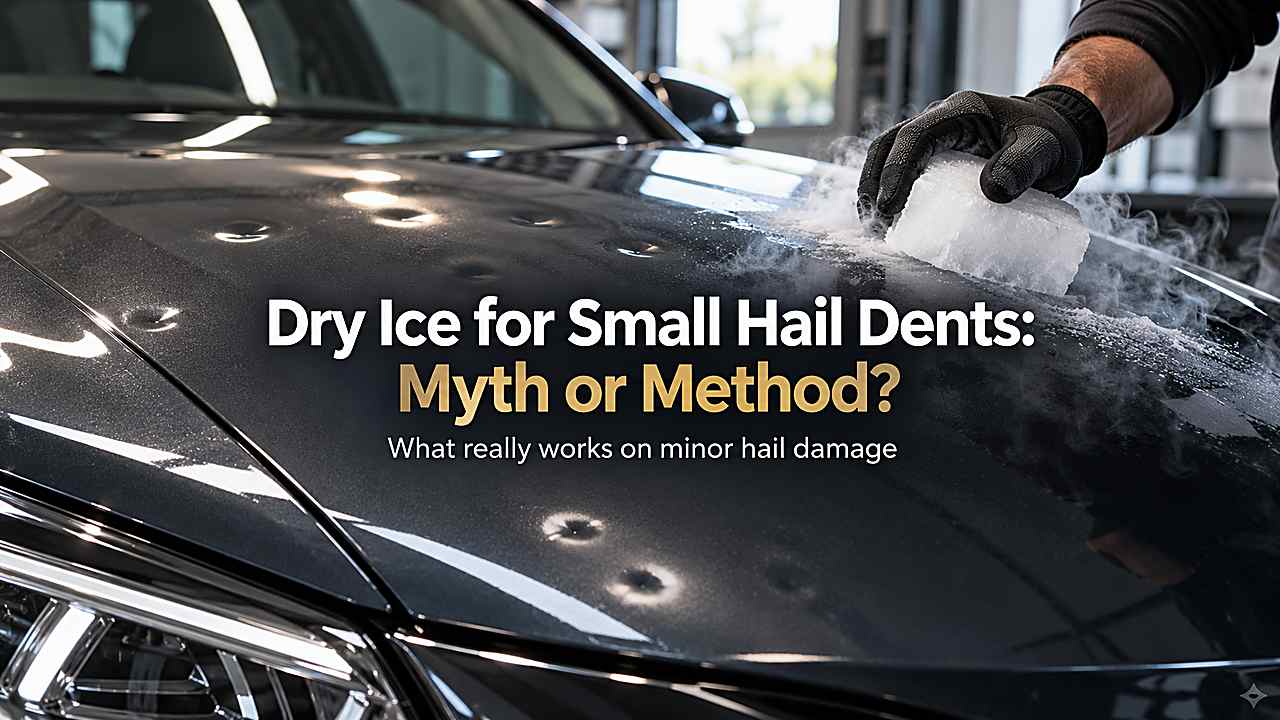
If you are researching using dry ice to remove small hail dents myth, the most useful answer is the one that separates what is technically possible from what is financially or practically sensible. Small details such as paint condition, local rules, temperature, material or policy wording can completely change the right choice.
This guide focuses on the decision points that matter in real ownership, not viral shortcuts or one-size-fits-all claims. You will see where a DIY step is reasonable, where documentation matters and where a professional or state-specific answer is safer.
Using dry ice to remove small hail dents is an unreliable DIY myth, not a controlled repair method. Rapid cooling may make metal move slightly, but it cannot accurately manage dent depth, crowns, stretch or paint condition, and repeated thermal shock can create additional problems.
Where the dry-ice dent myth came from
In this article, where the dry-ice dent myth came from matters because it changes the practical decision in ways that are easy to miss from a quick glance. The details below show what you should verify before you spend money, alter the surface or assume two similar-looking situations need the same solution.
The idea relies on rapid contraction of warm metal
Dry ice is extremely cold, so placing it on a warm panel creates a fast temperature difference. Because metals expand and contract with temperature, the idea sounds mechanically plausible. A hail dent, however, is not caused by uneven temperature. It is a physical deformation that has changed the panel shape and local tension.
When you evaluate the idea relies on rapid contraction of warm metal, treat it as one part of the decision rather than a shortcut. Compare it with the condition of your vehicle, the limits of the product or repair method, and any manufacturer, insurer or local requirements that apply before you move to a more aggressive step.
A pop is not proof of a finished repair
Some broad dents can snap between two positions, particularly on large open panels. Thermal change may trigger that movement. The panel can still contain a shallow low, crown or oil-can instability afterward. A dent that becomes less obvious in a casual photo may still be very visible under a PDR light.
When you evaluate a pop is not proof of a finished repair, treat it as one part of the decision rather than a shortcut. Compare it with the condition of your vehicle, the limits of the product or repair method, and any manufacturer, insurer or local requirements that apply before you move to a more aggressive step.
Why dry ice cannot control hail-dent geometry
In this article, why dry ice cannot control hail-dent geometry matters because it changes the practical decision in ways that are easy to miss from a quick glance. The details below show what you should verify before you spend money, alter the surface or assume two similar-looking situations need the same solution.
Hail damage is usually a field of individual impacts
A storm may leave dozens or hundreds of dents with different depths and locations. Some cross braces, body lines or roof rails. A uniform cold treatment cannot give each impact the different push or pull it needs. Professional hail repair is repetitive precisely because every dent has to be read and finished individually.
When you evaluate hail damage is usually a field of individual impacts, treat it as one part of the decision rather than a shortcut. Compare it with the condition of your vehicle, the limits of the product or repair method, and any manufacturer, insurer or local requirements that apply before you move to a more aggressive step.
Sharp centers and stretched metal need deliberate metal movement
Deep hail can create a tight center and surrounding crown. Cooling does not tell the crown where to go or remove excess surface area from stretched metal. If the dent moves suddenly, the stress can simply relocate. That is why experienced technicians make many small corrections instead of chasing a dramatic pop.
When you evaluate sharp centers and stretched metal need deliberate metal movement, treat it as one part of the decision rather than a shortcut. Compare it with the condition of your vehicle, the limits of the product or repair method, and any manufacturer, insurer or local requirements that apply before you move to a more aggressive step.
Paint and safety concerns with extreme cold
In this article, paint and safety concerns with extreme cold matters because it changes the practical decision in ways that are easy to miss from a quick glance. The details below show what you should verify before you spend money, alter the surface or assume two similar-looking situations need the same solution.
Dry ice can injure skin and must be handled as a hazardous cold material
Direct contact can cause frostbite, so gloves designed for cryogenic handling are necessary. Dry ice also releases carbon dioxide as it sublimates, which makes enclosed-space use unsafe without adequate ventilation. A car-detailing shortcut is not worth a personal injury. Safe handling alone makes the method impractical for casual experimentation.
When you evaluate dry ice can injure skin and must be handled as a hazardous cold material, treat it as one part of the decision rather than a shortcut. Compare it with the condition of your vehicle, the limits of the product or repair method, and any manufacturer, insurer or local requirements that apply before you move to a more aggressive step.
Very cold treatment can stress aged or compromised paint
Factory automotive paint experiences winter weather, but placing an ultra-cold solid directly on one small area creates a more concentrated thermal event. Repainted, cracked or brittle coatings may be less tolerant. If paint damage develops, the repair changes from PDR to conventional refinishing. That cost is much larger than the value of avoiding an estimate.
When you evaluate very cold treatment can stress aged or compromised paint, treat it as one part of the decision rather than a shortcut. Compare it with the condition of your vehicle, the limits of the product or repair method, and any manufacturer, insurer or local requirements that apply before you move to a more aggressive step.
What actually works for minor hail dents
In this article, what actually works for minor hail dents matters because it changes the practical decision in ways that are easy to miss from a quick glance. The details below show what you should verify before you spend money, alter the surface or assume two similar-looking situations need the same solution.
Paintless dent repair is designed for intact-paint hail damage
PDR technicians use rods from behind or glue-pull methods from the exterior to restore individual dents. Reflection lighting reveals minute lows and highs as the panel changes. When paint is intact and metal is not severely stretched, this can preserve the original finish. Hail is one of the classic applications for professional PDR.
When you evaluate paintless dent repair is designed for intact-paint hail damage, treat it as one part of the decision rather than a shortcut. Compare it with the condition of your vehicle, the limits of the product or repair method, and any manufacturer, insurer or local requirements that apply before you move to a more aggressive step.
Some very soft dents can be improved with suction, but finishing is the hard part
A suction tool may move a broad, shallow depression on a flat open panel. Hail dents are often too small for effective suction, and suction does not control the final texture. You can trade a low spot for a raised spot. That makes DIY suction a poor general solution for a hail field.
When you evaluate some very soft dents can be improved with suction, but finishing is the hard part, treat it as one part of the decision rather than a shortcut. Compare it with the condition of your vehicle, the limits of the product or repair method, and any manufacturer, insurer or local requirements that apply before you move to a more aggressive step.
How to handle a small hail claim without making damage worse
In this article, how to handle a small hail claim without making damage worse matters because it changes the practical decision in ways that are easy to miss from a quick glance. The details below show what you should verify before you spend money, alter the surface or assume two similar-looking situations need the same solution.
Document the car before touching dents
Clean the vehicle gently and photograph the roof, hood, trunk and upper sides in angled light. Keep notes about cracked glass or paint chips. If insurance may be involved, filing clear documentation before DIY work makes the starting condition easier to establish. Avoid techniques that can change the damage before inspection.
When you evaluate document the car before touching dents, treat it as one part of the decision rather than a shortcut. Compare it with the condition of your vehicle, the limits of the product or repair method, and any manufacturer, insurer or local requirements that apply before you move to a more aggressive step.
Get a PDR estimate before buying tools
A few small dents may cost less to repair professionally than you expect, especially if access is simple. Conversely, what looks like five dents in normal light can become fifty under reflection lighting. An estimate gives you a realistic scope. You can then decide whether cosmetic damage is worth repairing without gambling on thermal shock.
When you evaluate get a pdr estimate before buying tools, treat it as one part of the decision rather than a shortcut. Compare it with the condition of your vehicle, the limits of the product or repair method, and any manufacturer, insurer or local requirements that apply before you move to a more aggressive step.
Why thermal-shock experiments can complicate an insurance or PDR inspection
Hail estimators rely on the shape, depth and distribution of the original dents to choose a repair method and calculate labor. If you partially pull, heat or cold-shock some of those dents before an inspection, you can create mixed damage that is harder to classify. High spots, stretched centers and cracked refinishing may require different operations than the untouched hail dents around them. You should document the vehicle first if there is any chance you will make a comprehensive claim.
A professional PDR shop can also tell you whether the paint is original before glue pulling or other exterior work begins. That information matters because factory paint is generally more predictable than unknown repainting. Dry ice gives you no feedback about coating adhesion. Spending a few minutes on inspection and documentation preserves more repair options than experimenting with a method that cannot be finely controlled.
Why professional hail repair looks slow compared with a viral trick
A technician may spend several minutes on a dent that is smaller than a coin because the goal is not merely to move it outward. The tool tip is positioned under specific points while the reflection is watched continuously. Tiny highs are knocked down, crowns are relaxed and the panel texture is blended into the surrounding factory finish. That work is visually unimpressive on video because there is no dramatic single pop, but it is what makes the repair disappear from multiple viewing angles.
Hail jobs multiply that process across dozens or hundreds of impacts. A shortcut that could truly repair every dent with one temperature change would be valuable to the entire collision industry, yet professional hail work still relies on controlled pushes and pulls. The continued use of those precise methods is a practical clue that thermal-shock tricks do not deliver the same result.
There is also no reliable way to control how far the cold spreads through a panel. A small piece of dry ice can chill the paint, metal and any adhesive or insulation behind it at different rates. That unpredictability is especially undesirable near bonded roof braces and refinished panels. PDR gives the technician mechanical feedback with every push or pull, while thermal shock provides little feedback until the panel suddenly moves or the finish shows a problem. Predictability is the main reason to prefer controlled repair.
Frequently Asked Questions
These questions address the issues that most often cause confusion around using dry ice to remove small hail dents myth. They are useful for checking your plan before you spend money, alter the vehicle or rely on a rule that may not apply to your exact situation.
Can dry ice crack automotive paint?
It may not always crack sound factory paint, but concentrated extreme cold adds stress you do not need. Refinished, aged or already damaged coatings are more vulnerable. The larger problem is that even an undamaged finish does not mean the dent has been correctly repaired. A safer method controls the metal directly.
If your vehicle, policy or product falls outside the normal case, verify the exact instructions before acting. That extra check is especially worthwhile when the downside includes paint damage, broken glass or a disputed claim.
Does dry ice work better after heating the panel?
Heating first increases the temperature swing, which may increase panel movement but also increases thermal stress. It still does not give you control over highs, crowns or stretch. Combining two extremes makes the experiment more aggressive rather than more accurate. Professional PDR uses heat only in controlled support of metal movement.
The most reliable answer comes from the specific vehicle and documentation rather than an internet average. Keep photos, estimates and policy or product paperwork when they affect the decision.
Will dry ice remove door dings?
Door dings vary widely, and many have sharp centers or sit near braces. Dry ice does not solve access or geometry. A skilled technician can assess whether the ding is suitable for rod work or glue pulling. The same answer applies even if the dent is small.
You do not need to solve every variable yourself. A qualified repairer, glass shop, insurer or state regulator can confirm the details that are specific to your situation.
Is compressed-air upside-down cooling the same idea?
Yes. Viral methods that invert canned air use evaporative cooling to create a temperature drop. The underlying limitation is the same: temperature change is not controlled metal finishing. Aerosol propellants also introduce handling and surface risks.
If your vehicle, policy or product falls outside the normal case, verify the exact instructions before acting. That extra check is especially worthwhile when the downside includes paint damage, broken glass or a disputed claim.
What is the safest DIY action after minor hail?
Document the damage, protect broken glass from water, and avoid pushing or pulling dents until you know whether insurance or PDR will be involved. Cleaning the vehicle for inspection is fine if it can be done safely. The least aggressive first step preserves your repair options.
The most reliable answer comes from the specific vehicle and documentation rather than an internet average. Keep photos, estimates and policy or product paperwork when they affect the decision.
Conclusion
Using dry ice to remove small hail dents is an unreliable DIY myth, not a controlled repair method. Rapid cooling may make metal move slightly, but it cannot accurately manage dent depth, crowns, stretch or paint condition, and repeated thermal shock can create additional problems.
Your best next step is to verify the condition, documents or operating limits that control your specific case, then choose the least aggressive solution that fully addresses the problem. That approach gives you better odds of protecting the vehicle, your coverage and your budget at the same time.