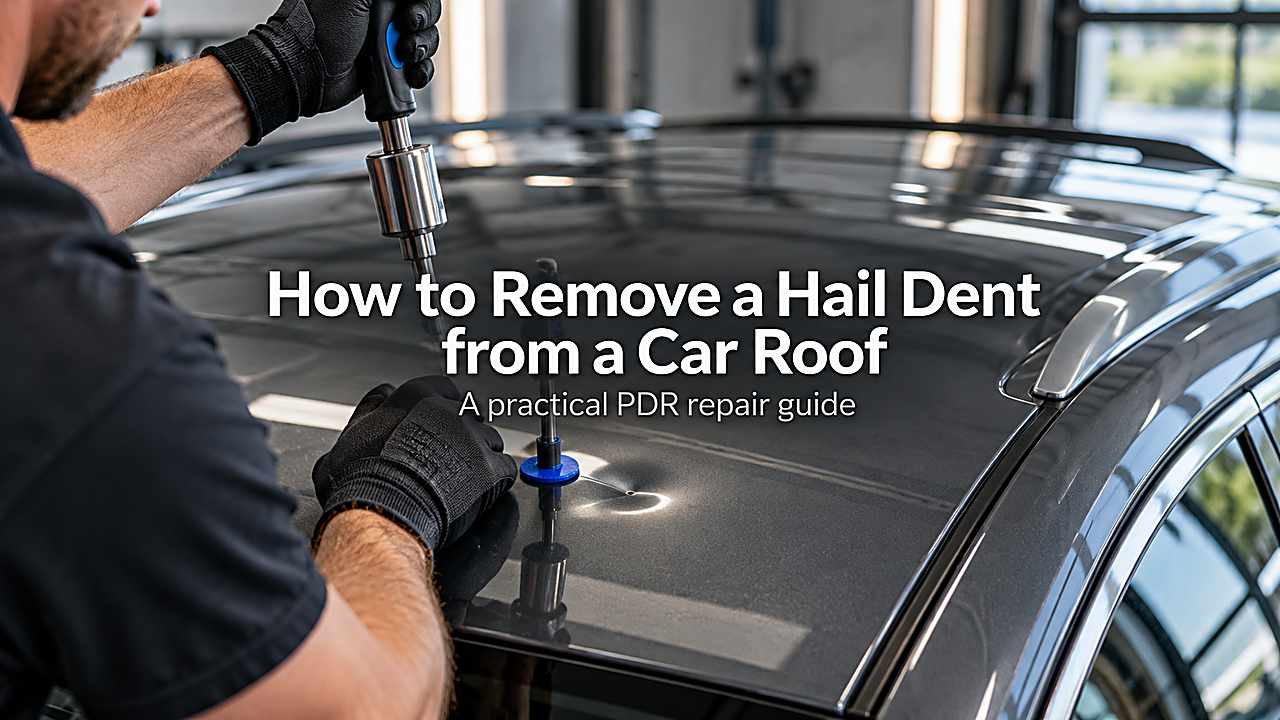
If you are researching how to remove a hail dent from a car roof, the most useful answer is the one that separates what is technically possible from what is financially or practically sensible. Small details such as paint condition, local rules, temperature, material or policy wording can completely change the right choice.
This guide focuses on the decision points that matter in real ownership, not viral shortcuts or one-size-fits-all claims. You will see where a DIY step is reasonable, where documentation matters and where a professional or state-specific answer is safer.
A hail dent in a car roof is usually best removed with paintless dent repair when the paint is intact. Technicians either gain controlled access above the headliner or use exterior glue pulling, then finish the metal under reflection lighting. Blind pushing from inside the cabin can damage the headliner, create high spots or interfere with roof components.
Why roof hail dents are a special repair
In this article, why roof hail dents are a special repair matters because it changes the practical decision in ways that are easy to miss from a quick glance. The details below show what you should verify before you spend money, alter the surface or assume two similar-looking situations need the same solution.
The roof is a large thin panel with braces underneath
A roof skin can flex over broad areas, but structural bows and adhesive separate sections of the outer panel. One dent may sit in open metal while another lies directly above a brace. Access therefore changes dent by dent. The same size impact can have very different repair difficulty depending on location.
When you evaluate the roof is a large thin panel with braces underneath, treat it as one part of the decision rather than a shortcut. Compare it with the condition of your vehicle, the limits of the product or repair method, and any manufacturer, insurer or local requirements that apply before you move to a more aggressive step.
Roof trim can hide airbags, wiring and sunroof hardware
Headliners are not empty decorative panels. Curtain-airbag areas, microphone wiring, lighting, antennas and sunroof drains may run behind them. Removing trim without the correct procedure can break clips or disturb safety components. This is one reason professional roof PDR often includes significant access labor.
When you evaluate roof trim can hide airbags, wiring and sunroof hardware, treat it as one part of the decision rather than a shortcut. Compare it with the condition of your vehicle, the limits of the product or repair method, and any manufacturer, insurer or local requirements that apply before you move to a more aggressive step.
How professional roof PDR works
In this article, how professional roof pdr works matters because it changes the practical decision in ways that are easy to miss from a quick glance. The details below show what you should verify before you spend money, alter the surface or assume two similar-looking situations need the same solution.
Backside rod work gives precise control when access is open
After safe trim removal, a technician positions a PDR light across the roof and makes tiny pushes from below. The reflected lines show whether the tool is exactly under the low spot. High areas are tapped down from outside as needed. The process is slow because a roof shows waves easily.
When you evaluate backside rod work gives precise control when access is open, treat it as one part of the decision rather than a shortcut. Compare it with the condition of your vehicle, the limits of the product or repair method, and any manufacturer, insurer or local requirements that apply before you move to a more aggressive step.
Glue pulling avoids some interior access
When paint is sound, glue tabs can lift dents from the exterior. This is useful over braces and in areas where removing the headliner would be excessive. The technician controls tab size, glue strength and pull direction, then blends high spots. Repainted roof panels need extra caution because adhesive pulling can lift weak refinishing.
When you evaluate glue pulling avoids some interior access, treat it as one part of the decision rather than a shortcut. Compare it with the condition of your vehicle, the limits of the product or repair method, and any manufacturer, insurer or local requirements that apply before you move to a more aggressive step.
What you can safely do yourself
In this article, what you can safely do yourself matters because it changes the practical decision in ways that are easy to miss from a quick glance. The details below show what you should verify before you spend money, alter the surface or assume two similar-looking situations need the same solution.
Document and clean the roof before attempting anything
Wash away grit and inspect the dent under angled reflections. Check the paint at the deepest point for cracks. Photograph roof rails, sunroof edges and any glass damage. A clear assessment helps you decide whether the dent is a PDR candidate before tools are involved.
When you evaluate document and clean the roof before attempting anything, treat it as one part of the decision rather than a shortcut. Compare it with the condition of your vehicle, the limits of the product or repair method, and any manufacturer, insurer or local requirements that apply before you move to a more aggressive step.
Avoid pressing on the headliner
Pushing upward through the fabric can stretch, crease or detach the headliner and gives you no accurate view of the tool contact point. Even if the dent moves, you can create a high spot. Do not drill or cut access holes simply to reach a minor hail dent. Factory openings and noninvasive methods should come first.
When you evaluate avoid pressing on the headliner, treat it as one part of the decision rather than a shortcut. Compare it with the condition of your vehicle, the limits of the product or repair method, and any manufacturer, insurer or local requirements that apply before you move to a more aggressive step.
When roof damage needs more than PDR
In this article, when roof damage needs more than pdr matters because it changes the practical decision in ways that are easy to miss from a quick glance. The details below show what you should verify before you spend money, alter the surface or assume two similar-looking situations need the same solution.
Cracked paint means the finish also needs repair
PDR can reshape metal but cannot replace missing clear coat or color. If hail chipped paint to metal, the area should be protected from corrosion. A body shop may use PDR-style metal correction before refinishing, but the final job is no longer purely paintless. Do not ignore a roof chip because it is small.
When you evaluate cracked paint means the finish also needs repair, treat it as one part of the decision rather than a shortcut. Compare it with the condition of your vehicle, the limits of the product or repair method, and any manufacturer, insurer or local requirements that apply before you move to a more aggressive step.
Large stretched dents and damaged roof rails can indicate severe impact
If the roof edge, rail, sunroof opening or windshield frame is distorted, the damage deserves collision-shop assessment. Those areas contribute to body structure and sealing. A cosmetic dent in the middle of the roof is a different category. PDR should not be used to hide structural deformation.
When you evaluate large stretched dents and damaged roof rails can indicate severe impact, treat it as one part of the decision rather than a shortcut. Compare it with the condition of your vehicle, the limits of the product or repair method, and any manufacturer, insurer or local requirements that apply before you move to a more aggressive step.
Insurance considerations for multiple roof dents
In this article, insurance considerations for multiple roof dents matters because it changes the practical decision in ways that are easy to miss from a quick glance. The details below show what you should verify before you spend money, alter the surface or assume two similar-looking situations need the same solution.
Hail often creates far more dents than you first see
Professional lighting may reveal a dense field across the roof and hood. If you carry comprehensive coverage, obtain a full estimate before deciding that one visible dent is not worth a claim. Headliner removal and roof access can make the repair more expensive than simple door dings. Compare the entire hail estimate with your deductible.
When you evaluate hail often creates far more dents than you first see, treat it as one part of the decision rather than a shortcut. Compare it with the condition of your vehicle, the limits of the product or repair method, and any manufacturer, insurer or local requirements that apply before you move to a more aggressive step.
Do not alter the damage before documentation if a claim is likely
Take photos and report the loss before permanent DIY repair when practical. An insurer or shop may need to establish the original scope. Emergency glass protection is different from cosmetic metal work. Preserving the starting condition makes the claim easier to explain.
When you evaluate do not alter the damage before documentation if a claim is likely, treat it as one part of the decision rather than a shortcut. Compare it with the condition of your vehicle, the limits of the product or repair method, and any manufacturer, insurer or local requirements that apply before you move to a more aggressive step.
Why a single roof dent may still justify a professional estimate
Roof access can dominate the labor even when only one dent bothers you. A technician may have to loosen pillar trim, dome-light components or part of the headliner to reach the metal safely. If the dent lies over a roof brace, glue pulling may be preferable. That is why roof PDR pricing does not always match the price of an equally sized door ding.
Ask the technician whether the quoted work includes trim removal and reinstallation and whether any calibration or special procedure is needed for roof-mounted electronics. A clear estimate lets you compare professional repair with simply living with a cosmetic dent. It also prevents you from risking a headliner or airbag component to save money on what looked like a small low spot.
A clean roof finish makes PDR assessment more accurate
Tree sap, water spots and dirt can distort reflections and hide the exact edge of a shallow hail dent. Wash the roof gently before an estimate and avoid aggressive polishing that could remove evidence of paint cracking. If the car has ceramic coating, wax or PPF, tell the technician because exterior glue pulling may require special surface preparation. The repair method can change even when the dent itself looks identical.
After repair, inspect the roof from front, side and rear under straight reflected lines. A broad roof panel can look perfect from one angle while a shallow wave remains from another. Good PDR finishing should restore the flow of the entire reflection. This is especially important on black and other dark colors that make subtle distortion obvious in sun.
If the roof has PPF, vinyl wrap or aftermarket paint, mention that before the estimate. Glue-pull adhesive may interact differently with those surfaces, and removing film can add labor or reveal prior paintwork. Likewise, panoramic glass roofs leave less metal area but can make access around the remaining roof skin more complex. A technician who knows the exact roof construction can choose a method that protects both the finish and the expensive components surrounding it.
Roof access is often the deciding factor in a successful PDR repair
A roof dent may look open from the outside while the underside is blocked by braces, roof bows, wiring or the headliner. Professional PDR technicians use lighting to map the low spot and then decide whether controlled rod pressure, glue pulling or a combination will provide safe access. If headliner removal is required, curtain airbags and trim fasteners have to be handled correctly. You should not probe blindly from inside the roof because a tool can damage wiring, crease the headliner or create new high spots in the roof skin.
Large shallow roof dents can be easier than small sharp impacts
Diameter alone does not tell you whether a hail dent is repairable. A broad shallow depression with intact paint may move gradually back toward the original contour, while a small deep dent on a body line or beside a roof edge can contain more stretch and concentrated tension. Inspect the paint for cracking and look at the dent in reflected light before trying any DIY method. If the metal is sharply folded, unstable or connected to a damaged roof rail, a body-shop assessment is safer than repeated pulling.
Frequently Asked Questions
These questions address the issues that most often cause confusion around how to remove a hail dent from a car roof. They are useful for checking your plan before you spend money, alter the vehicle or rely on a rule that may not apply to your exact situation.
Can I push a roof dent out with my hand from inside?
Not safely through the headliner. You cannot see the exact pressure point, and the roof may have braces or components in the way. A broad soft dent may move, but a high spot can be created instantly. Proper PDR uses precise tools and reflection lighting.
The most reliable answer comes from the specific vehicle and documentation rather than an internet average. Keep photos, estimates and policy or product paperwork when they affect the decision.
Does the headliner always have to come out?
No. Some dents can be glue-pulled from outside, and partial trim access may be enough for others. The location of braces and the number of dents determine the approach. A technician should choose the least invasive safe access route.
You do not need to solve every variable yourself. A qualified repairer, glass shop, insurer or state regulator can confirm the details that are specific to your situation.
Can suction cups fix roof hail dents?
Small hail dents are usually too tight for ordinary suction cups. A large shallow roof depression may respond, but suction does not provide fine finishing control. PDR rods and glue tabs are more precise. Do not overpull a flexible roof skin.
If your vehicle, policy or product falls outside the normal case, verify the exact instructions before acting. That extra check is especially worthwhile when the downside includes paint damage, broken glass or a disputed claim.
Will roof PDR damage curtain airbags?
A trained technician should identify airbag areas and follow proper trim-removal procedures. The metal repair itself does not require disturbing airbags when access is planned correctly. Blindly inserting tools near roof rails is the risky behavior to avoid.
The most reliable answer comes from the specific vehicle and documentation rather than an internet average. Keep photos, estimates and policy or product paperwork when they affect the decision.
How long does roof hail PDR take?
A few isolated dents can be repaired in hours, while a hail-damaged roof with dozens of dents and headliner removal can take much longer. Aluminum, braces and body lines add time. A complete vehicle hail job may take days depending on severity and shop workload.
You do not need to solve every variable yourself. A qualified repairer, glass shop, insurer or state regulator can confirm the details that are specific to your situation.
Conclusion
A hail dent in a car roof is usually best removed with paintless dent repair when the paint is intact. Technicians either gain controlled access above the headliner or use exterior glue pulling, then finish the metal under reflection lighting. Blind pushing from inside the cabin can damage the headliner, create high spots or interfere with roof components.
Your best next step is to verify the condition, documents or operating limits that control your specific case, then choose the least aggressive solution that fully addresses the problem. That approach gives you better odds of protecting the vehicle, your coverage and your budget at the same time.