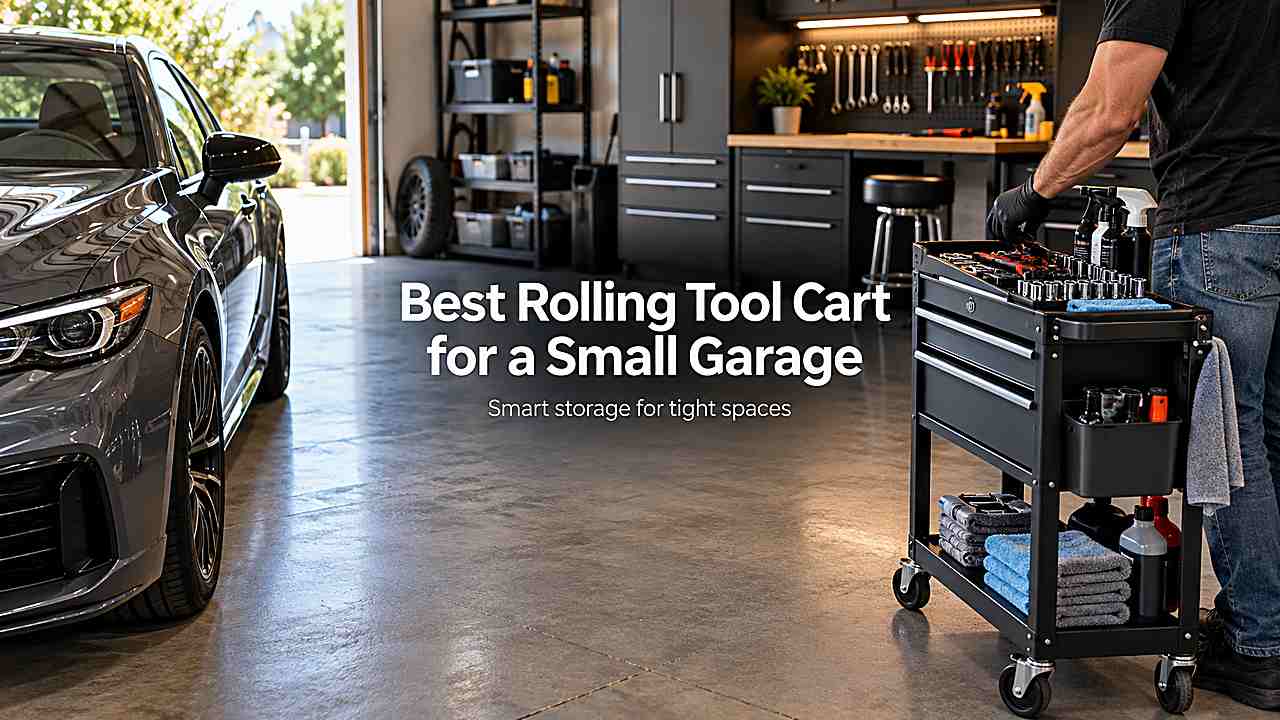
For most small garages, a 30-inch four- or five-drawer mechanics cart is the sweet spot. Harbor Freight’s U.S. General 30-inch five-drawer cart is a strong value pick because it carries a useful home-mechanic tool collection without consuming the footprint of a full roll cabinet, while Husky’s compact mechanics carts are another good choice when you want an open lower shelf.
Measure the cart with the side handle and the lid open before buying. In a narrow garage, a cart that technically fits against the wall can still block the driver’s door once you start working.
Choose a 30- to 33-inch cart with shallow drawers for hand tools, locking casters and a useful top work area. U.S. General offers strong value; Husky is a good alternative if shelf storage matters.
Why a cart is better than a large cabinet in a tight garage
A cart moves to the side of the car so the tools you use most stay within reach. A full cabinet stores more but usually stays against the wall.
In a one-car or narrow two-car garage, mobile access can matter more than maximum drawer volume. That detail matters because it changes how safely and efficiently the job can be completed. You should choose the tool or method around the actual vehicle and working conditions rather than a headline specification.
What this means for your setup
Good preparation also reduces the amount of expensive equipment you need. Clean surfaces, correct access and a clear workflow often matter more than buying the most powerful version of every tool. When safety is involved, manufacturer procedures and rated equipment take priority over internet shortcuts. Saving a few minutes is never worth creating a lifting, electrical or braking hazard.
Best value style: U.S. General 30-inch five-drawer
The five-drawer mechanics-cart format gives you shallow drawers for sockets and wrenches, a deep top compartment and a bottom tray. It is widely used in home and professional garages because storage per dollar is strong.
The lid needs overhead clearance when open. A controlled process is usually faster in the end because it prevents rework. If one step begins behaving differently from what you expect, stop and inspect before adding more force, heat, pressure or chemical strength.
Best alternative: Husky 33-inch mechanics cart
Husky offers compact carts with a top compartment, drawers and open bottom shelf. The shelf is useful for a jack, fluid bottles or tool cases that do not fit drawers.
An open shelf collects more dust but increases versatility. Good preparation also reduces the amount of expensive equipment you need. Clean surfaces, correct access and a clear workflow often matter more than buying the most powerful version of every tool.
Four or five drawers are enough for a working cart
Your rolling cart should hold the tools needed for the current job, not your entire garage. Put specialty pullers, power tools and rarely used equipment in fixed storage.
This keeps the cart lighter and easier to move. Think about storage and repeat use as well as the immediate job. A product that works perfectly once but is awkward to store, service or replace can become a poor home-garage choice over time.
What this means for your setup
Your best result comes from matching capacity to the task with some margin. Running tools continuously at their limit creates heat, wear and frustration even when the specification says the job is technically possible. A controlled process is usually faster in the end because it prevents rework. If one step begins behaving differently from what you expect, stop and inspect before adding more force, heat, pressure or chemical strength.
Drawer depth matters more than drawer count
Shallow drawers are efficient for sockets, wrenches and pliers because you can see everything in one layer. Deep drawers encourage stacking.
Use the bottom area for larger items and keep the top clear as a temporary parts surface. When safety is involved, manufacturer procedures and rated equipment take priority over internet shortcuts. Saving a few minutes is never worth creating a lifting, electrical or braking hazard.
Measure the aisle with the vehicle parked
Open the car door, put the jack where you normally use it and then measure the remaining pathway. Include the cart handle and drawer extension.
A cart that sticks out four extra inches can make the garage frustrating every day. Your best result comes from matching capacity to the task with some margin. Running tools continuously at their limit creates heat, wear and frustration even when the specification says the job is technically possible.
Caster quality affects whether you will actually move it
Larger quality casters roll over floor joints and extension cords more easily. At least two casters should lock securely.
Do not load the top so heavily that the cart becomes unstable when a drawer is open. That detail matters because it changes how safely and efficiently the job can be completed. You should choose the tool or method around the actual vehicle and working conditions rather than a headline specification.
What this means for your setup
Good preparation also reduces the amount of expensive equipment you need. Clean surfaces, correct access and a clear workflow often matter more than buying the most powerful version of every tool. When safety is involved, manufacturer procedures and rated equipment take priority over internet shortcuts. Saving a few minutes is never worth creating a lifting, electrical or braking hazard.
Magnetic accessories add storage without a bigger cart
Magnetic trays, paper-towel holders and spray-can racks can use the cart’s vertical sides. Add only the accessories you reach for constantly.
Too many side attachments make a compact cart wider and easier to snag on the car. A controlled process is usually faster in the end because it prevents rework. If one step begins behaving differently from what you expect, stop and inspect before adding more force, heat, pressure or chemical strength.
A worktop is useful, but protect painted parts
A steel top is convenient for tools but can scratch trim, lamps and painted components. Use a removable rubber mat or padded tray for delicate parts.
Keep brake and engine parts separate from detailing towels. Good preparation also reduces the amount of expensive equipment you need. Clean surfaces, correct access and a clear workflow often matter more than buying the most powerful version of every tool.
When a narrow cabinet makes more sense
If the cart will rarely move and you need secure drawer storage, a 26- to 27-inch narrow rolling cabinet can use wall space efficiently. A mobile mechanics cart is better when you routinely roll tools beside the vehicle.
Think about storage and repeat use as well as the immediate job. A product that works perfectly once but is awkward to store, service or replace can become a poor home-garage choice over time.
What this means for your setup
Your best result comes from matching capacity to the task with some margin. Running tools continuously at their limit creates heat, wear and frustration even when the specification says the job is technically possible. A controlled process is usually faster in the end because it prevents rework. If one step begins behaving differently from what you expect, stop and inspect before adding more force, heat, pressure or chemical strength.
How to choose without overspending
A controlled process is usually faster in the end because it prevents rework. If one step begins behaving differently from what you expect, stop and inspect before adding more force, heat, pressure or chemical strength. Think about storage and repeat use as well as the immediate job. A product that works perfectly once but is awkward to store, service or replace can become a poor home-garage choice over time.
Use drawer liners and labels to keep the compact cart efficient
Thin non-slip liners stop sockets from sliding every time you move the cart. Labeling wrench and socket drawers reduces the temptation to pile tools on top. A small cart works best when every item returns to the same place.
Keep heavy sockets and hammers low, light electrical tools higher and chemicals on a separate shelf or side tray. Lower weight improves stability when a drawer is open.
Plan where the cart parks when the job is finished
A rolling cart that has no home becomes a permanent obstacle. Measure a parking spot under a bench, beside a cabinet or against a wall before you buy. Include the side handle, power-strip bracket and magnetic accessories in the footprint.
If the lid opens upward, check shelves and garage-door tracks above the parking location. A cart that fits only when the lid is closed can still be annoying if you cannot access the top compartment where it lives.
Do not fill every drawer on day one
Leave some empty capacity for the tools that naturally migrate to the cart as you work. If every drawer is packed at purchase, new specialty sockets and electrical tools end up on the top tray and the cart becomes cluttered again. A little unused space is part of good organization.
Reevaluate the drawer layout after several projects. The tools you reach for most should live between waist and chest height, while heavy or occasional tools can stay lower. Organization should follow your workflow, not a showroom photo.
Frequently Asked Questions
Small-garage storage is a space-planning problem first and a drawer-count problem second.
What size tool cart is best for a one-car garage?
Around 30 inches wide is a useful starting point because it provides real drawer space without dominating the aisle. Measure your garage with the vehicle present.
The best size is the largest cart that can still move where you need it. Good preparation also reduces the amount of expensive equipment you need. Clean surfaces, correct access and a clear workflow often matter more than buying the most powerful version of every tool.
Are U.S. General tool carts good for home mechanics?
They are widely regarded as strong value because of drawer capacity and price. Assembly and steel thickness are not the same as premium tool-truck carts, but home users usually do not need that level of construction.
Think about storage and repeat use as well as the immediate job. A product that works perfectly once but is awkward to store, service or replace can become a poor home-garage choice over time.
Should you buy a tool cart with a lid?
A lid secures the top compartment and creates organized storage, but it needs vertical space to open. Shelves or wall cabinets above the cart can interfere.
Measure before buying. When safety is involved, manufacturer procedures and rated equipment take priority over internet shortcuts. Saving a few minutes is never worth creating a lifting, electrical or braking hazard.
Is an open shelf better than more drawers?
It depends on your tools. An open shelf handles bulky cases, fluids and power tools well, while drawers protect smaller tools from dust.
A mixed layout is often best in a small garage. Your best result comes from matching capacity to the task with some margin. Running tools continuously at their limit creates heat, wear and frustration even when the specification says the job is technically possible.
How much weight should a tool cart hold?
Enough for your intended tool load with a healthy margin. Check total and individual drawer ratings.
Heavy sockets belong low in the cart to keep the center of gravity stable. That detail matters because it changes how safely and efficiently the job can be completed. You should choose the tool or method around the actual vehicle and working conditions rather than a headline specification.
Conclusion
Choose a 30- to 33-inch cart with shallow drawers for hand tools, locking casters and a useful top work area. U.S. General offers strong value; Husky is a good alternative if shelf storage matters. The safest and most cost-effective result comes from choosing capacity and technique for the real job rather than buying or using more than the situation requires.
If the vehicle, tool or procedure falls outside what you can verify confidently, use the manufacturer’s service information or a qualified technician. Good garage work is repeatable, controlled and safe.