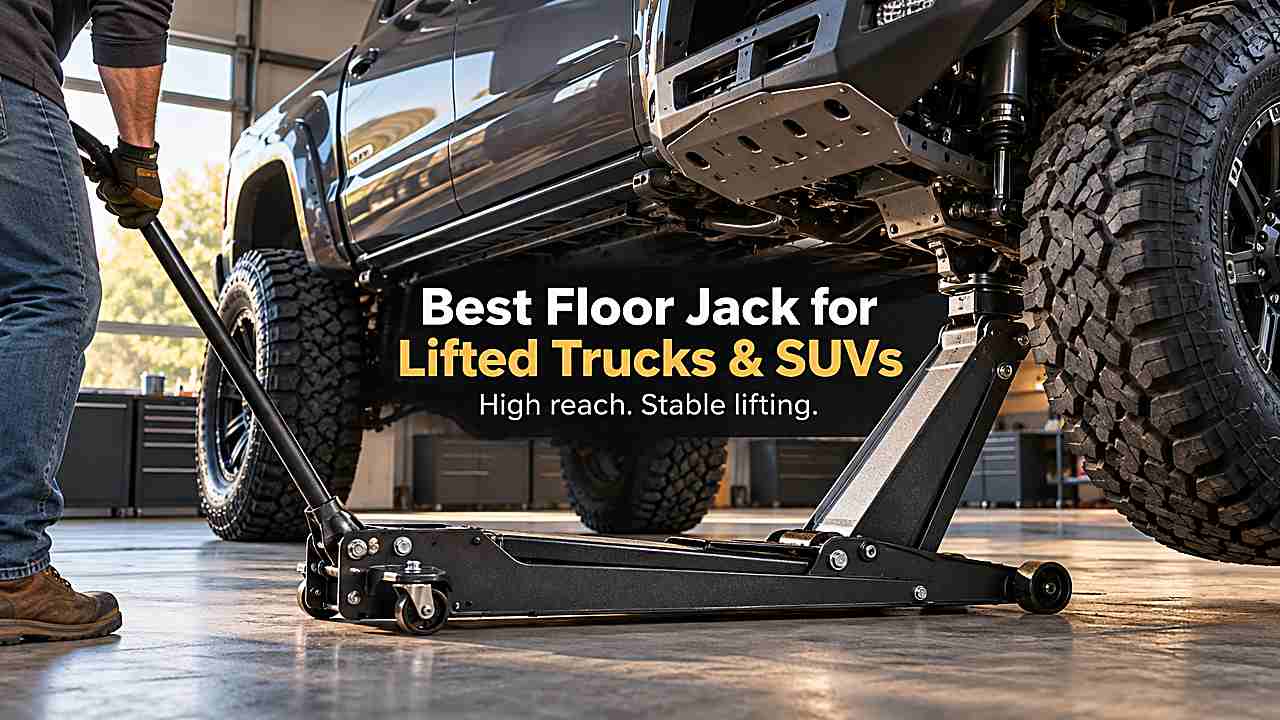
For most lifted trucks and SUVs on a smooth garage floor, the DAYTONA 3-ton long-reach floor jack is a strong choice because it lifts from roughly 3¼ inches to 24¼ inches and has a long chassis for reaching central lift points. For significantly lifted or off-road vehicles, the BADLAND 3-ton off-road jack reaches about 29 inches and includes a locking height extension.
A jack must both fit under the lift point and raise it high enough for your stands to reach approved support points. Tire size and suspension droop can make a normal 18-inch jack effectively useless on a lifted truck.
DAYTONA’s 3-ton long-reach jack is the best garage choice for many trucks and SUVs; BADLAND’s 29-inch off-road jack is better when you need substantially more lift height or use rougher surfaces.
Capacity is only the first specification
A 3-ton jack does not need to lift the entire weight of a 6,000-pound truck at once, but adequate rated capacity is essential. You also need enough maximum lift height, usable saddle geometry and stability.
Always support the vehicle on properly rated stands after lifting. That detail matters because it changes how safely and efficiently the job can be completed. You should choose the tool or method around the actual vehicle and working conditions rather than a headline specification.
What this means for your setup
Good preparation also reduces the amount of expensive equipment you need. Clean surfaces, correct access and a clear workflow often matter more than buying the most powerful version of every tool. When safety is involved, manufacturer procedures and rated equipment take priority over internet shortcuts. Saving a few minutes is never worth creating a lifting, electrical or braking hazard.
Best garage pick: DAYTONA 3-ton long-reach
Harbor Freight currently lists the DAYTONA long-reach model at a 6,000-pound capacity with a lift range around 3¼ to 24¼ inches. The low starting height also makes it useful on other cars in the garage.
Its 50-inch handle and long chassis help reach deeper lift points. A controlled process is usually faster in the end because it prevents rework. If one step begins behaving differently from what you expect, stop and inspect before adding more force, heat, pressure or chemical strength.
Best high-lift/off-road choice: BADLAND 3-ton
The BADLAND off-road jack currently reaches about 29-1/16 inches using its locking saddle extension. Large composite wheels and a full-length skid plate make it more suitable for rough surfaces than a conventional steel-caster floor jack.
It still requires a flat, level working area as specified by the manufacturer. Good preparation also reduces the amount of expensive equipment you need. Clean surfaces, correct access and a clear workflow often matter more than buying the most powerful version of every tool.
Measure your truck before buying the jack
Park on level ground and measure from the floor to the approved lift point. Then estimate how much additional height is needed to raise the tire clear and allow the jack stand to reach its support point.
Suspension droop on trucks can be substantial, especially at the axle or control arm. Think about storage and repeat use as well as the immediate job. A product that works perfectly once but is awkward to store, service or replace can become a poor home-garage choice over time.
What this means for your setup
Your best result comes from matching capacity to the task with some margin. Running tools continuously at their limit creates heat, wear and frustration even when the specification says the job is technically possible. A controlled process is usually faster in the end because it prevents rework. If one step begins behaving differently from what you expect, stop and inspect before adding more force, heat, pressure or chemical strength.
Long-reach versus high-lift are different needs
A tall jack is not helpful if the chassis cannot reach a central crossmember. A long-reach jack solves underbody access but may still need a compatible extension for a very tall lift point.
Identify where you will actually jack the vehicle before choosing. When safety is involved, manufacturer procedures and rated equipment take priority over internet shortcuts. Saving a few minutes is never worth creating a lifting, electrical or braking hazard.
Use only approved saddle extensions
Do not stack wood blocks or loose adapters on a normal saddle to gain height. Use a manufacturer-approved extension designed to lock or seat securely.
An unstable stack can shift as suspension geometry changes during lifting. Your best result comes from matching capacity to the task with some margin. Running tools continuously at their limit creates heat, wear and frustration even when the specification says the job is technically possible.
Jack stands must match the lifted vehicle too
Tall trucks need stands with enough reach and capacity. A high-lift jack paired with short stands does not create a safe work setup.
Check that the stand saddle fits the approved support point and that the base sits flat on the floor. That detail matters because it changes how safely and efficiently the job can be completed. You should choose the tool or method around the actual vehicle and working conditions rather than a headline specification.
What this means for your setup
Good preparation also reduces the amount of expensive equipment you need. Clean surfaces, correct access and a clear workflow often matter more than buying the most powerful version of every tool. When safety is involved, manufacturer procedures and rated equipment take priority over internet shortcuts. Saving a few minutes is never worth creating a lifting, electrical or braking hazard.
Off-road jacks do not make uneven ground safe
Larger wheels and a skid plate improve mobility on gravel or dirt, but the vehicle should still be lifted on a stable, level surface according to the jack instructions. Chock the wheels and avoid side slopes.
Recovery lifting and maintenance lifting are different tasks. A controlled process is usually faster in the end because it prevents rework. If one step begins behaving differently from what you expect, stop and inspect before adding more force, heat, pressure or chemical strength.
Weight and storage matter
A long-reach steel jack can weigh more than 100 pounds, while off-road designs can still exceed 70 pounds. This is garage equipment, not something most people enjoy moving into a truck bed regularly.
If portability matters, compare aluminum models and accept the tradeoffs. Good preparation also reduces the amount of expensive equipment you need. Clean surfaces, correct access and a clear workflow often matter more than buying the most powerful version of every tool.
How to choose without overspending
A controlled process is usually faster in the end because it prevents rework. If one step begins behaving differently from what you expect, stop and inspect before adding more force, heat, pressure or chemical strength. Think about storage and repeat use as well as the immediate job. A product that works perfectly once but is awkward to store, service or replace can become a poor home-garage choice over time.
Saddle size and adapter fit matter on trucks
Truck lift points can be broad frame rails, round axles or manufacturer-specific pads. A small bare steel saddle may not fit every point well. Rubber pads and approved saddle adapters can improve contact and protect coatings, but they also add height to the minimum position.
Before buying an extension, verify that it locks or nests securely with the jack. Loose blocks or universal stacks can shift as the jack rolls and the suspension changes angle. Stable contact is more important than gaining the last inch of height.
Axle lifting and frame lifting produce very different height needs
If you lift a solid axle directly under the differential or axle tube where approved, the suspension does not droop the same way it does when you lift the frame. That can dramatically reduce the jack height needed for tire service. Frame lifting may be necessary for suspension work, but then the axle can hang several extra inches before the tire clears.
Decide which jobs you actually perform. A 24-inch long-reach jack can be excellent for garage tire and brake work even if a 29-inch off-road jack looks more impressive on paper.
The best jack still needs a safe storage and maintenance routine
Hydraulic jacks should be stored where the lifting arm cannot be damaged and the release valve is protected from impact. Inspect for fluid leaks, damaged casters, bent components and saddle wear before use. A jack that slowly loses height under no load or shows damaged hardware should be serviced or removed from use.
Keep the floor around the jack clean so its casters can roll as the arm rises. Blocking the wheels against debris can force the jack to pull sideways on the lift point. Smooth movement is part of safe lifting geometry.
Frequently Asked Questions
Lifted vehicles make ordinary jack recommendations less useful because suspension droop and lift-point height can exceed what a standard floor jack was designed to handle.
Is a 3-ton jack enough for a full-size truck?
Often, but you must compare the jack’s rated capacity with the actual lifting load and follow the vehicle and jack instructions. You are normally lifting one end or corner rather than the entire vehicle.
Heavier commercial trucks may require more capacity. Good preparation also reduces the amount of expensive equipment you need. Clean surfaces, correct access and a clear workflow often matter more than buying the most powerful version of every tool.
How high should a jack lift for a lifted truck?
High enough for the tire or component to clear while the jack stand can reach the approved support point. Measure your own truck because lift kit height and suspension travel differ.
A 24-inch jack may work for one lifted SUV and be too short for another. Think about storage and repeat use as well as the immediate job. A product that works perfectly once but is awkward to store, service or replace can become a poor home-garage choice over time.
Can you use jack extensions safely?
Only extensions designed and approved for the specific jack or saddle system. Loose stacked blocks can shift and are unsafe.
A locking extension, such as those used on purpose-built high-lift jacks, is a better solution. When safety is involved, manufacturer procedures and rated equipment take priority over internet shortcuts. Saving a few minutes is never worth creating a lifting, electrical or braking hazard.
Is an off-road jack safe on gravel?
Some off-road jacks are designed with larger wheels and skid plates for rougher surfaces, but manufacturers still call for flat stable ground. Soft or sloped terrain can shift under load.
Use solid support and wheel chocks. Your best result comes from matching capacity to the task with some margin. Running tools continuously at their limit creates heat, wear and frustration even when the specification says the job is technically possible.
Do lifted trucks need taller jack stands?
Yes if normal stands cannot reach the approved support points after the vehicle is lifted. Choose stands with adequate height and load rating.
Never extend a stand beyond its rated adjustment. That detail matters because it changes how safely and efficiently the job can be completed. You should choose the tool or method around the actual vehicle and working conditions rather than a headline specification.
Conclusion
DAYTONA’s 3-ton long-reach jack is the best garage choice for many trucks and SUVs; BADLAND’s 29-inch off-road jack is better when you need substantially more lift height or use rougher surfaces. The safest and most cost-effective result comes from choosing capacity and technique for the real job rather than buying or using more than the situation requires.
If the vehicle, tool or procedure falls outside what you can verify confidently, use the manufacturer’s service information or a qualified technician. Good garage work is repeatable, controlled and safe.