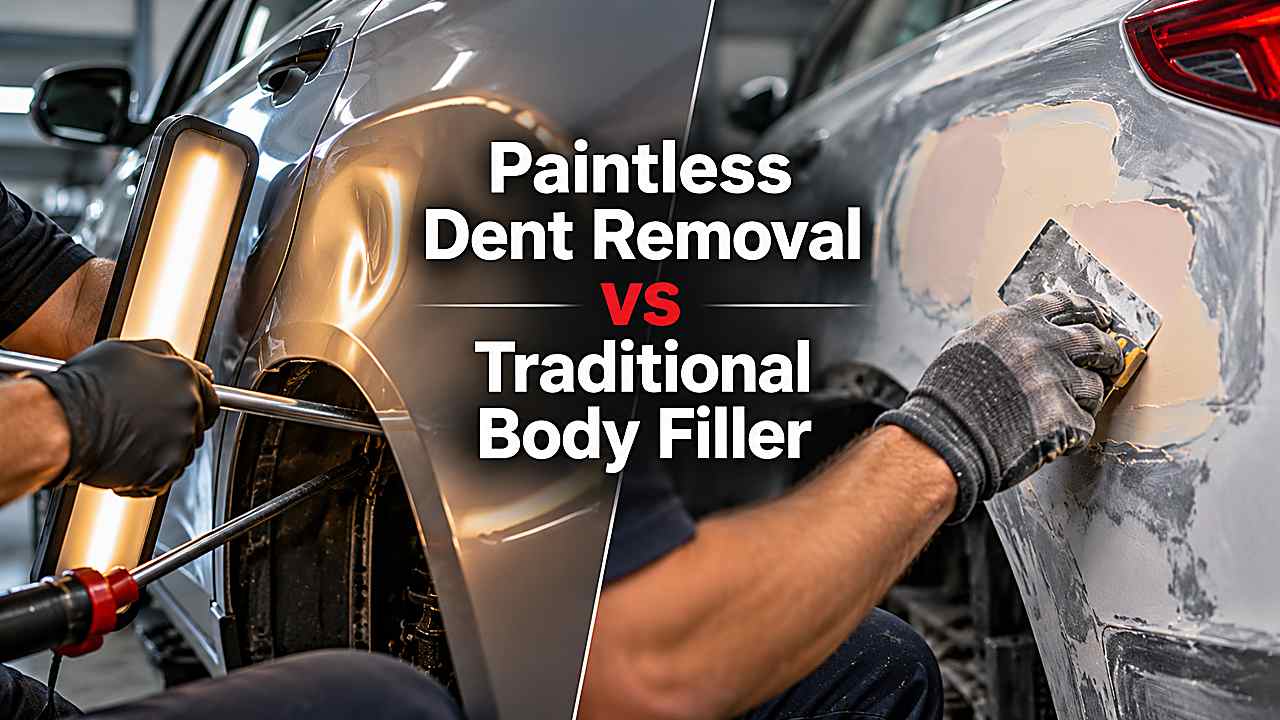
Paintless dent removal and traditional body filler are not competing solutions for exactly the same damage. PDR is designed to restore a dent while preserving intact paint, whereas conventional body repair becomes necessary when the panel or coating needs more extensive correction.
Understanding the difference helps you evaluate estimates without assuming that “no filler” is always superior or that every dent needs sanding and paint. The condition of the metal and finish should decide the method.
Choose PDR when the paint is intact and the dent can be reshaped to a stable final contour. Traditional metal work, filler and refinishing are more appropriate when paint is broken, metal is severely stretched or the surface cannot be restored paintlessly.
How the two repair methods differ
PDR reshapes the original panel and preserves the existing finish, while traditional body repair reshapes the panel as needed, uses filler to refine remaining surface irregularities, then primes and repaints the area.
Paintless dent removal works with the original panel surface
The technician accesses the dent from behind or pulls it from the exterior, then refines the metal with many small corrections. No filler is needed when the panel can be restored to final contour and the paint remains sound. The main limitation is that PDR cannot replace missing paint or solve every stretched or sharply damaged panel.
Those details should be considered together rather than in isolation. A technician can often identify the limiting factor by reading the panel under proper light and checking access behind it. That assessment is more reliable than judging the repair from dent width alone.
Body filler is part of a broader refinishing system
Filler is not intended to replace proper metal straightening. A body technician first restores the panel as close as practical, then uses a controlled layer of filler to perfect the surface before primer and paint. When performed correctly, this method can repair damage that is unsuitable for PDR.
The surrounding panel matters as much as the most obvious low spot. Braces, edges, previous work and material type can change the amount of control available to the technician. A good estimate explains which of those conditions is driving the recommended method.
Which method preserves more original material and finish
PDR preserves the factory coating when successful, while filler repair necessarily introduces new surface materials and paint.
Why original paint can be valuable
Factory paint has already been matched to the vehicle and applied under controlled manufacturing conditions. Keeping it avoids blend decisions, texture matching and future questions about why a panel was refinished. That advantage matters only when the existing coating is healthy enough to preserve.
This is why two dents that appear similar in a phone photo can receive different quotes. One may offer clean access and stable paint while the other sits over a brace or repaired area. The difference reflects labor and risk rather than arbitrary pricing.
Why repainting is sometimes the correct repair
If an impact has cracked, scraped or removed paint, preserving an already damaged finish is not a meaningful goal. Deep folds and stretched metal may also need conventional finishing to achieve a stable, smooth result. In those situations, filler and refinishing are not inferior by definition; they are tools for a different class of damage.
A careful repair plan also considers what must remain untouched. Preserving sound paint, trim and panel geometry is part of the job, not an afterthought. The least invasive method is useful only when it can still deliver a stable, convincing finish.
Cost, repair time and convenience
PDR often uses fewer material stages and can be faster for qualifying dents, while conventional repair adds surface preparation, curing and paint operations.
Why PDR can cost less
A straightforward PDR job avoids paint materials, booth time and color blending. Mobile service may also be possible for certain dents. Difficult PDR can still be labor-intensive, so it is not automatically cheap simply because no paint is used.
The practical limit becomes clearer once the technician can see how the panel carries tension around the damage. That tension determines where force should be applied and where it should not. Controlled movement is what separates a refined repair from a quick cosmetic pop.
Why traditional repair can take longer
Conventional repair may include disassembly, metal work, filler shaping, primer, sanding, basecoat, clear coat, curing and reassembly. Color matching or blending can expand the working area beyond the dent itself. Those steps add time but are necessary when the finish or metal cannot be restored paintlessly.
Previous repairs can change this calculation substantially. A panel that contains filler or uncertain refinish paint may not tolerate the same pushing or pulling as original material. Disclosing known repair history helps the shop avoid unnecessary coating or surface damage.
Durability and long-term appearance
Both methods can be durable when used appropriately and performed well; the important difference is what remains on the panel after repair.
A proper PDR repair does not rely on a patch
Once the metal is restored to a stable contour, there is no filler layer that must hold the shape. The original coating remains over the repaired area. A correctly finished PDR dent should not simply pop back because the technician has relieved and redistributed the deformation rather than temporarily holding it outward.
Access is another reason a simple-looking dent can become time-consuming. Interior trim, reinforcement and closed sections may block the ideal tool path. The technician may need disassembly or an exterior pulling strategy to work the area accurately.
Quality body filler depends on preparation
Modern automotive fillers are designed for thin, properly prepared applications over sound substrates. Problems are more likely when filler is applied too thickly, over contamination, corrosion or poorly prepared metal. A reputable body shop treats filler as a finishing material within a complete repair process.
The expected finish should be discussed before work starts. Some difficult damage can be restored completely, while other cases are better described as improvement work or candidates for refinishing. Clear expectations make it easier to compare repair options fairly.
How to choose between PDR and filler repair
Repairability is never decided by diameter alone. Depth, sharpness, stretched material, paint condition, panel edges, braces and tool access can turn two similar-looking dents into very different jobs. The correct method follows the damage rather than a blanket preference for one technique.
Choose PDR when the finish and metal allow it
Intact paint, manageable depth, good access and limited stretching favor PDR. Door dings, hail dents and many shallow impacts fit this profile. Body lines and larger dents can also qualify, but technician skill becomes increasingly important.
Trying to force the wrong method usually creates more work. Over-pushing, repeated suction or aggressive pulling can introduce highs and coating stress that were not present after the original impact. Stopping early is often cheaper than correcting a failed experiment.
Choose conventional repair when the damage requires it
Broken paint, severe stretching, torn metal, heavy collision deformation and previous filler can move the job toward conventional repair. A body shop can also address corrosion and structural damage that cosmetic PDR is not designed to solve. The best estimate explains why a method fits your specific panel.
A photo estimate is useful for screening, but it cannot reveal every hidden condition. An in-person check can confirm panel material, access, coating condition and previous repair clues. That final inspection is the right point to confirm price and repair expectations.
A practical inspection checklist before you approve the repair
Before authorizing work, inspect the damage in clean, dry conditions and look at it from several angles rather than straight on. Note whether the finish is cracked, whether the dent crosses a character line or edge, and whether the panel has known previous repairs. These observations help the estimator choose a method and help you understand why one quote may differ from another.
1. Confirm the finish condition.
Look for chips, hairline cracks, peeling clear coat, scuffs that cut through color and signs of an older refinish. Paint condition determines whether a genuinely paintless final result is possible and whether exterior pulling methods carry additional risk. Do not polish or aggressively compound the area before inspection because that can make subtle coating damage harder to interpret.
If the coating is already broken, say so when requesting a quote. The metal may still be reshaped with PDR techniques, but the final job may need touch-up or refinishing. That distinction prevents a low initial quote from being mistaken for a complete cosmetic repair.
2. Show the dent’s shape and location clearly.
A useful photo set includes a wide view of the whole panel and angled views that let reflections cross the dent. Include nearby edges, handles, trim and body lines because location affects both stiffness and tool access. For a crease, photograph along its length so the estimator can see whether the line is soft, sharp or folded.
Avoid judging the job by diameter alone. Depth and shape often reveal more about repair difficulty than width, and an apparently minor dent can be challenging when it sits over a brace or at a hemmed edge. A clear description of where the damage sits saves time during the estimate.
3. Ask what result and method the quote assumes.
A professional estimate should make clear whether the goal is a complete PDR restoration, a major improvement, or conventional repair followed by refinishing. Ask about necessary trim removal, exterior pulling, paint risk and any circumstances that could change the price after access begins. The cheapest number is not useful if it describes less work than the competing quote.
Also ask how the shop handles unexpected previous repairs or hidden filler. A technician may reasonably stop and discuss options if the panel behaves differently from factory metal once work begins. That pause protects the finish and gives you control over whether to continue with a different repair method.
Frequently Asked Questions
Is PDR always better than body filler?
No. PDR is less invasive for qualifying damage, but it cannot restore missing paint or solve every severe deformation. Traditional repair is the correct method when the panel needs refinishing or more extensive surface correction.
Those details should be considered together rather than in isolation. A technician can often identify the limiting factor by reading the panel under proper light and checking access behind it. That assessment is more reliable than judging the repair from dent width alone.
Does body filler mean the repair is low quality?
Not when it is used correctly. Professional body repair uses filler as a thin finishing material after the metal has been properly repaired and prepared. Poor preparation or excessive thickness is a workmanship problem, not proof that all filler repairs are bad.
The surrounding panel matters as much as the most obvious low spot. Braces, edges, previous work and material type can change the amount of control available to the technician. A good estimate explains which of those conditions is driving the recommended method.
Which repair is faster?
PDR is often faster for suitable dents because it eliminates primer, paint and curing stages. A complex PDR job can still take substantial technician time. Conventional repair generally needs more process steps, especially when color blending is required.
This is why two dents that appear similar in a phone photo can receive different quotes. One may offer clean access and stable paint while the other sits over a brace or repaired area. The difference reflects labor and risk rather than arbitrary pricing.
Which repair is cheaper?
PDR is often less expensive for minor qualifying dents because paint materials and refinishing labor are avoided. Large or difficult PDR can be costly, and conventional repair prices vary with damage and paint operations. Compare complete quotes for the actual repair rather than assuming one method always wins on price.
A careful repair plan also considers what must remain untouched. Preserving sound paint, trim and panel geometry is part of the job, not an afterthought. The least invasive method is useful only when it can still deliver a stable, convincing finish.
Can PDR be used before body filler?
Yes, PDR-style metal manipulation can sometimes reduce a dent before conventional refinishing. That can minimize how much filler is needed and improve the underlying metal shape. Once the panel is sanded or painted as part of the repair, however, the finished job is not purely paintless.
The practical limit becomes clearer once the technician can see how the panel carries tension around the damage. That tension determines where force should be applied and where it should not. Controlled movement is what separates a refined repair from a quick cosmetic pop.
Conclusion
Paintless dent removal preserves original paint and avoids filler when the dent is a suitable candidate. Traditional body repair uses metal work, filler and refinishing to solve damage that PDR cannot fully address.
Do not choose based on the method’s name alone. Ask the estimator to explain the paint condition, metal stretch, access and expected finish, then use the least invasive method that can restore the panel correctly.