How PDR works, what makes a dent a good candidate, and what the method cannot promise.
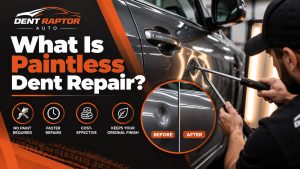
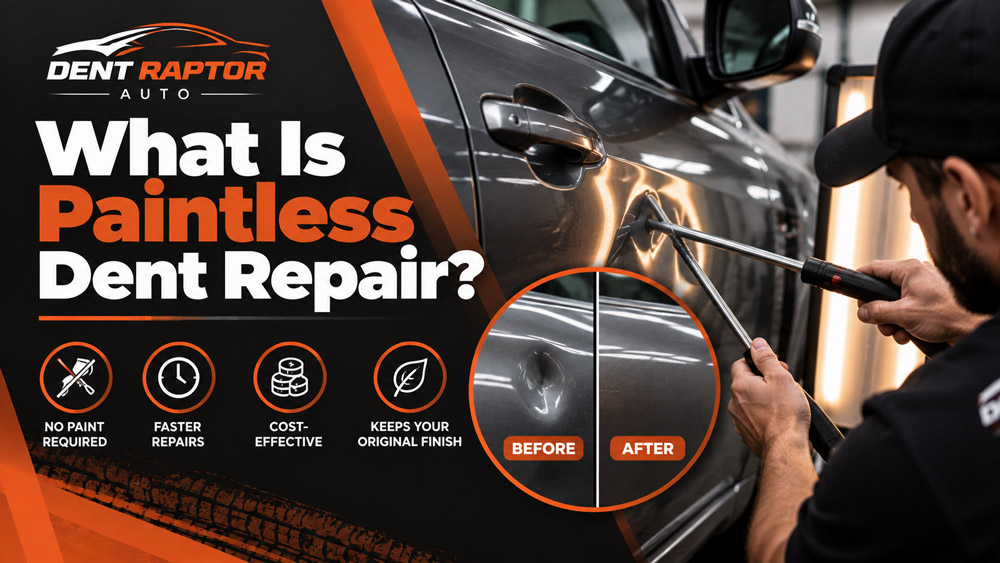
Paintless dent repair, usually shortened to PDR, is a way of removing dents and dings without paint or fillers. The Dent Raptor Auto Google listing explains the method in the owner’s own words: it uses specialized tools and techniques to gently massage the metal back into its original shape from behind the panel. Instead of filling a dent and repainting the area, a technician works the metal itself. That single idea is what separates PDR from a conventional body repair.
The method depends on two conditions. First, the paint film needs to be intact. If the paint has cracked, chipped, or stretched past its limit, a paintless repair will not restore the finish, and a different repair is the honest answer. Second, the technician usually needs some way to reach behind the panel. Many repairs happen through the back of a door, fender, or hood, which can mean moving trim or a liner aside. When the back of a panel cannot be reached, a pulling method from the outside may be used instead.
Most PDR candidates fall into a few familiar categories. Door dings from a parking lot are the classic case. Hail damage is another, and it is one the owner’s description names directly, along with minor collisions and creases or wrinkles in metal panels. Each of those situations shares the same useful trait: the metal is pushed in, but the paint that covers it survived the impact.
The tool kit is specialized but not mysterious. Technicians use rods, picks, and levers shaped to press the metal from the inside. A light board or a reflected line is used to read the panel, because a dent that looks obvious in one light can nearly vanish in another. The technician watches the reflection change as the metal moves, and stops when the surface reads level again. The final step is a contour check under light, so high and low spots are addressed before the vehicle goes back to its owner.
The advantages of the method are easy to understand. Because there is no filler, sanding, or repainting, the factory finish is preserved. The owner’s description notes that PDR is often faster, more affordable, and more environmentally friendly than traditional body repair for that reason. There is less material, less drying time, and less risk of a color mismatch, because the original paint is never removed.
The limits are just as important. PDR is not a universal repair. A sharp crease that folds the metal along a body line can be much harder than a large round dent, because the metal is bent rather than simply pushed. Deep damage, stretched metal, broken paint, or rust all change the recommendation. A responsible technician will tell a customer when a dent is not a paintless candidate rather than trying to force the method onto damage it cannot fix.
For a driver in Oneonta, the practical next step is simple. Describe what happened, point out every spot you want addressed, and share a photo taken in daylight. A photo starts the conversation, but the real assessment happens when the panel is in front of a technician under proper light. That is when the honest answer comes: paintless repair, a different repair, or a conversation about whether the dent needs attention at all.
It is also worth thinking about timing. A dent that is left alone is usually harmless, so there is rarely a rush unless the damage is spreading, the paint is at risk of cracking further, or a sale is approaching. Choosing to wait is a valid decision as long as it is an informed one, and a short phone call is the cheapest way to make it.
Paintless dent repair is best understood as a precise method with a clear boundary. It shines on the shallow, paint-intact damage that makes up most parking-lot and hail incidents. When the damage crosses that boundary, the value of an experienced technician is not a promise that PDR will work, but a clear explanation of what will. Call Dent Raptor Auto at (607) 376-7799 to talk through the damage on your vehicle.