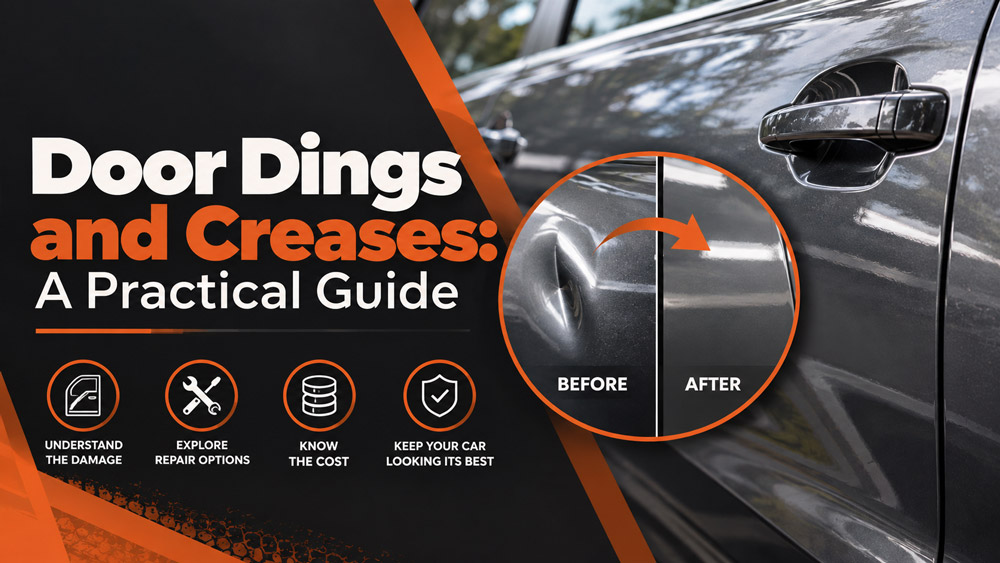
Why a tiny ding can be simple, why a crease can be stubborn, and how to prepare for a repair.
A door ding is one of the most common reasons a driver looks into paintless dent repair, and one of the most misunderstood. It looks like a small problem, and often it is. But the same impact that leaves a harmless-looking dimple in one spot can produce a stubborn crease a few inches away, and the difference has nothing to do with how large the mark appears. Understanding that difference makes it easier to set a realistic expectation before a repair.
Start with what a ding actually is. A shopping cart, an opening door, or a stray ball pushes a small area of metal inward. If the paint film stretches without breaking, the metal can usually be persuaded back toward its original shape from behind the panel. The Dent Raptor Auto listing names door dings directly among the damage paintless dent removal is used for, and this is the profile that fits: shallow, paint-intact, and reachable.
A crease is a different animal. Instead of a rounded push, the metal is folded along a line. That fold can stiffen the panel and spread the distortion along its length, which is why a crease can resist the same techniques that work on a round dent. When a crease crosses a character line, a wheel arch, or the edge of a panel, the technician has to work the metal back across the fold rather than simply lifting a low spot. It takes patience and a good read of the reflection.
Location matters as much as depth. A ding in the broad, flat middle of a door is usually the most cooperative. The same ding near a door handle, along a body line, or at the very edge of a panel can be harder, because the surrounding metal is stiffer and access is tighter. A technician will often run a hand along the panel and study the reflection before saying anything about scope, precisely because two similar-looking dents can behave very differently.
Paint condition is the deciding factor for whether paintless repair is even the right path. If the paint is intact, the factory finish can be preserved, which is the main advantage the method offers. If the paint has cracked or chipped, the finish is part of the damage, and a paintless repair alone will not bring it back. That is a case where an honest shop steers the conversation toward body and paint work rather than promising a result the method cannot deliver.
Preparing for a repair is simple. Point out every spot you care about, including the ones that are easy to overlook. Move personal items away from door pockets and interior trim, since a technician may need to remove a panel to reach the back of the metal. If you have a photo taken in daylight, bring it, but expect the technician to find additional small dents once the panel is under a light. Agree on what is in scope before the work begins.
It helps to think about why you are repairing the damage at all. A ding is usually harmless to the vehicle’s function; the reasons to fix it are appearance and resale. On a leased vehicle or one you plan to sell, a clean panel can change how the car presents, and paintless repair keeps the original finish intact. On a vehicle you plan to keep for years, a small ding may simply not be worth the time, and that is a fair conclusion too.
The takeaway is that small damage still deserves a real assessment. A round ding and a folded crease can look similar in a photo and behave completely differently under a technician’s tools. The honest path is to describe what happened, show the spots that bother you, and let the panel be read under proper light. For door dings and creases in Oneonta, call Dent Raptor Auto at (607) 376-7799 to start the conversation.