Paintless Dent Repair (PDR)
The Google listing for Dent Raptor Auto describes paintless dent removal in the owner's own words: it removes dents and dings without paint or fillers by massaging the metal back into shape from behind the panel. This page expands on what that means for a driver in Oneonta, what the method can and cannot promise, and what to have ready before a visit.
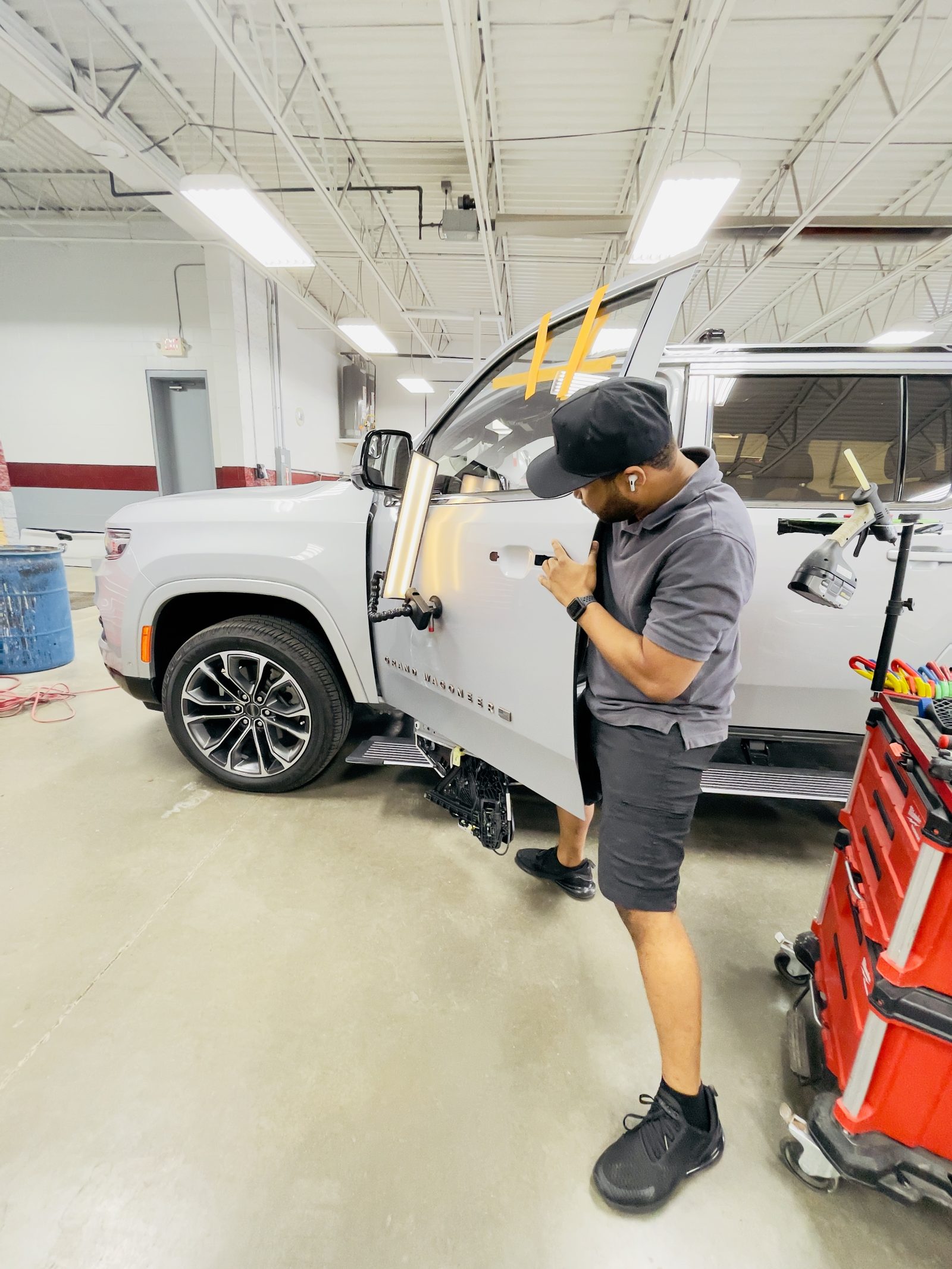
Paintless dent repair, explained in plain language
The Google listing for Dent Raptor Auto describes paintless dent removal in the owner's own words: it removes dents and dings without paint or fillers by massaging the metal back into shape from behind the panel. This page expands on what that means for a driver in Oneonta, what the method can and cannot promise, and what to have ready before a visit.
Paintless dent repair fits a specific kind of damage: a dent or ding where the metal has been pushed in but the paint film is still intact. When the paint has not cracked, chipped, or stretched past its limit, a technician can often work the panel from the back side and return the metal toward its original contour instead of filling and repainting it. That is the core idea the owner describes in the business's Google listing.
The drivers who ask about PDR in Oneonta usually have one of a few situations in front of them: a parking-lot door ding, a shopping-cart dent, a shallow crease from a low-speed bump, or a panel of small dents left behind by a hailstorm. Those are the exact cases the owner's description names, along with creases and wrinkles in metal panels.
PDR is not a universal answer. If paint is already broken, if the metal is sharply folded, or if a panel is creased hard along a body line, a traditional repair may be the more honest path. A technician can usually tell the difference in person, which is why a clear photo and a short description are worth more than a confident guess.
What this service generally includes
- Access to the back of the panel. Many repairs require the technician to reach behind the panel, which can mean moving interior trim, a lamp, or a liner aside first.
- Dent-specific hand tools. Technicians use rods, picks, and levers shaped to press the metal back toward its original shape from the inside.
- Glue-pull where access is limited. When the back of a panel cannot be reached, a pulling method may be used from the outside instead.
- Reflection and light-board inspection. A reflected line or a light board is used to read the panel and judge when the surface is level again.
- No filler, sanding, or repainting. The owner's description notes that PDR avoids fillers, sanding, and repainting when the paint is intact.
- Final contour check. The panel is reviewed under light at the end so high and low spots are addressed before the vehicle is returned.
What affects scope and timing
Access is the first thing that changes scope. A dent in the middle of a door may be straightforward, while the same dent near a window frame or a reinforced beam can be much harder to reach. The location matters as much as the size.
The second factor is the metal and the paint. Sharp creases, stretched metal, and paint that has already cracked all reduce what paintless repair can achieve. Aluminum panels and some high-strength steels also behave differently from older mild steel, so a technician judges each panel on the vehicle in front of them. Depth and count round out the list, because one shallow ding is a different job from a full panel of hail dents.
How to prepare
Wash the area, or at least wipe it down, so the technician can see the actual surface. Dirt and road film hide small dents and make an accurate read harder.
Gather a short description: what happened, roughly when, and which panels are involved. If you have a photo taken in daylight, bring it, but understand that a photo starts the conversation rather than setting the final scope.
After the visit
After a PDR visit, keep the repaired area clean and avoid heavy pressure washing directly at the panel for a short time. Check the repair in daylight from a few angles. If something looks off, contact the shop promptly rather than waiting.
PDR versus traditional body repair
Traditional body repair commonly uses filler, sanding, and repainting to restore a panel. PDR is a different method that keeps the original finish when the paint is intact, which is why the owner's description calls it often faster, more affordable, and more environmentally friendly.
That does not make PDR better in every case. It is one method among several, and the correct choice depends on the damage. A shop that can explain both paths is more useful than one that promises a single method will always work.
Questions people ask about paintless dent repair (pdr)
Can every dent be repaired with PDR?
No. PDR depends on intact paint and reasonable access behind the panel. Sharp creases, stretched metal, or cracked paint usually point toward a different repair.
Does PDR really avoid repainting?
When the paint film is intact, the process is designed to restore the panel contour without fillers, sanding, or repainting. That is the method the owner describes.
How do I know which dents qualify?
Describe the damage and send a clear photo, then let the shop assess it. A final answer is best given after the panel is seen in person.
Eliminate the dent without the hassle
Call Dent Raptor Auto at 3 Miles Ave Ste 2 in Oneonta to describe the damage, ask about mobile or drop-off service, or check what is on the lot.